
Book Review: Dining Out
A global history of restaurants

Other Book Reviews
Joan DeJean, How Paris Became Paris
Dining Out: A Global History of Restaurants
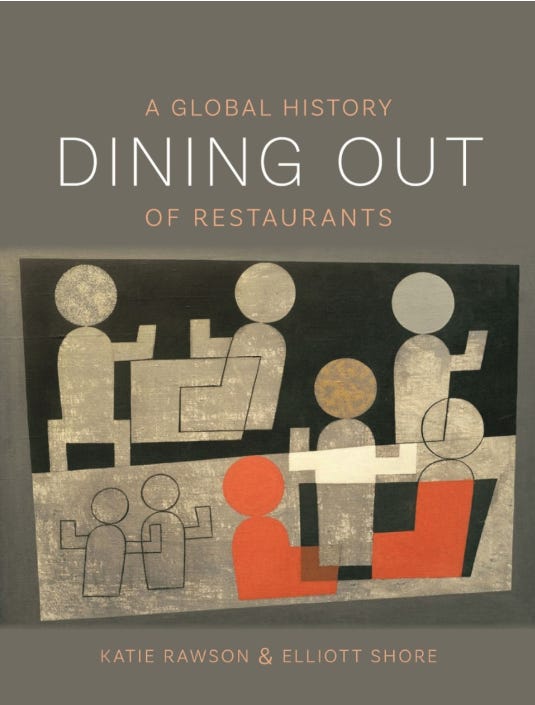
Reviewed: Katie Rawson and Elliot Shore, Dining Out: A Global History of Restaurants (London: Reaktion Books, 2019).
The short title Dining Out poses its own historical problems. The phrase “dining out” includes connotations in present-day English that presume modern social constructions about households and families. While Rawson and Shore do not consider this question specifically, they trace the history of hospitality as far back as ancient Greece, where dining at kapeleia was common. In addition to Athens, taverns proliferated in Pompeii as well. These were practices of communal meals. The authors, however, propose an inversion in present times, “In many ways‚ eating at home is now an extension of eating out‚ rather than the other way around.” (9)
Communal meals--sometimes known as the practice of commensality, from mensa, “table” and com, “come together”—were served at various types of venues all over the world for more than a millennium before the emergence of the restaurant. From the long tavern culture of China sprung the first restaurants during the Song Dynasty in the twelfth-century. Kaifeng, Song’s dynastic capitol, had a population of over a million people. It is not clear, however, how these venues in Kaifeng are distinguished from stalls and cookshops in the same city. “To eat in a restaurant is to eat in public‚ interacting with people who are not related to us and who are performing a service for which they are rewarded” (10) does not distinguish restaurants from taverns. “Restaurants in their fullest version, and in the way we experience them now, rely on service and choice” (24) distinguishes restaurants from taverns, cookshops, and stalls; however, nothing in the narrative about these venues in twelfth-century Kaifeng and Hangzhou illustrate their classifications as restaurants. The authors also claim that Marco Polo dined in restaurants during his visit to China in 1275.
Meanwhile, teashops and cafés offered non-restaurant alternatives to taverns. Tsuen Tea opened in Uji, Japan in 1160 and persists in present times. About 500 years later, coffee and cafés emerged in Europe. Present-day Venice is home to Caffé Florian, which opened in 1720. The European version of the restaurant was a French invention. Although the name first applied to a weak consommé, “restaurant” referred to a place after the 1760s. Mathurin Roze de Chantoiseau opened his cookshop specializing in beef broth, while marketing to a contemporary health fashion counter to the rich foods previously preferred by the aristocracy. Yet selling weak beef broth was not a sound business model, and these cookshops experimented with two approaches. The obvious alternative was an expanded menu with appeal to a broader array of diners. The other was modernizing service. Instead of old innkeepers’ modes of service, some of these early restaurants served diners at any time and seated them at small tables. The French restaurant reached maturation between 1789 and 1793.
“The shifting culture of the sixteenth century turned the minimalist simplicity and purposeful frugality of the early tea ceremony into an elaborate event cuisine, laying the ground for kaiseki cuisine; however, these changes manifested differently in Kyoto and Edo (now Tokyo). Japanese restaurants writ large developed out of both high and low teahouse culture in the late seventeenth century; however, the formal teahouses of Kyoto and Edo were where the best-known lineage of chefs emerged in Japan.” (88)
Three centuries after the wave of innovative chefs of sixteenth-century Japan, European chefs were modernizing the restaurant kitchen. The initial development of the gas stove between 1802 and 1836 exposed kitchen workers to fewer noxious gases and allowed them to control heat better. Alexis Soyer (1810–1858) and Auguste Escoffier (1846–1935) both contributed to kitchen technology, while innovating French menus. Carême defined the four mother sauces in the 1830s; by 1903, however Escoffier restructured these as the five mother sauces we know today. Escoffier also introduced the restaurant organization of kitchen space and staff known as the brigade de cuisine.
Part of this modern system of restaurant professionalism included waiters and maître d’hotels. Japan was again a leader in service‚ where innkeepers employed waitresses to serve travelers on the highways between Edo and Kyoto. In nineteenth-century French restaurants, the head waiter acted as a manager of the front-of-the-house, while waiters generally maintained control over the guests’ dining experience. Waiters could advance to the highest positions in restaurants and hotels. Oscar Tschirky advanced from busboy to waiter. After a decade of working in restaurants, he was hired as maître d’hotel of the new Waldorf Hotel in New York. Starting as a waiter, César Ritz worked across Europe as a manager and maître d’hotel before starting his own hotels.
Although some aspects of the development of restaurants were themselves urban phenomena, some important aspects of dining out catered to travelers on remote locations along highways. By the nineteenth century, however, the steam locomotive produced a new kind of land travel, which induced some new needs for dining out. Lunch stands and restaurants operated at train depots. The more radical innovation for land transportation, however, offered the possibility of dining without stopping after the Pullman car was introduced in 1868. The emergence of the automobile produced a new realm of possibilities for road food, that were not dependent on the timetables of passenger trains. Thus started the era of roadside diners. Since these remotely-located restaurants lacked a robust regular clientele, reputations with the locals was replaced by travelers’ guides, such as the Michelin Guide. In the case of the Green Book, the guide informed black travelers of the establishments where they were safe and welcomed.
While technology was long a critical part of advancing the efficiency and quality of prepared food, during the late 1890s, there was the introduction of the first machines that served it. First, there were self-service restaurants known as buffets or cafeterias, with kitchens and dining rooms arranged to facilitate self service. Meanwhile, inventors had been tinkering with mechanical food and drink vending. By the early twentieth century, the automat emerged as a self-service dining system that completely removed direct contact between customers and food servers. This coincided with experiments with food served over a system of conveyor belts.
Just as tavernkeepers were local entrepreneurs, many local restauranteurs just operated a single venue. However, the modern trend in hospitality is expansion through corporate chains. McDonald’s is the defining example of a modern restaurant chain. Even pre-corporate McDonald’s opted to maximize speed and efficiency, both by changing from carhop service to self-service and by conceiving of their own type of brigade de cuisine.
Yet hospitality has always been a global phenomenon. In the early chapters of Dining Out, the authors point out the various ancient and early modern cultures contributions to foodways. In the chapter “Global Dining,” they bring us into the present times. Modern restaurants have counterparts in China, France, and Germany. Yet Chinese foodways are traveling over the globe, with variations of these cuisines introduced worldwide by emigres.
Dining Out is an ambitious narrative spanning over two millennia and capturing hospitality venues in Europe, Asia, and North America. Its introduction to the history of ancient taverns is a must read. Similarly with its narratives of tea houses and restaurants in early modern China and Japan. Another strong narrative is the development of kitchen organization and modern standards of service in the nineteenth century. Dining Out is worth reading for these narratives alone. Yet this book failed to articulate and develop a thesis. Nor did it directly challenge the reader to explore what dining out is. However, Dining Out is a valuable text for foodways and the history of restaurants just for the breadth of the examples.