
David Robert Saunders
Telegrapher, Inventor, and Weather Reporter

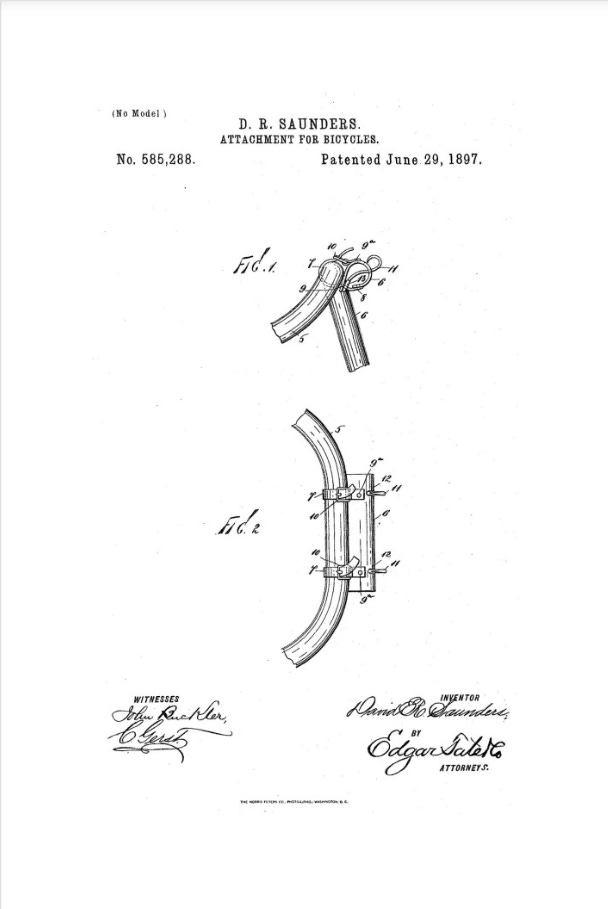
Image 1. D. R. Saunders, “Attachment for Bicycles,” 29 June 1897, United States Patent No. 585,288, Portal to Texas History.
Introduction
David Robert Saunders (1844-1920) was a railroad telegrapher, inventor, and weather reporter in Houston.
Saunders was born 25 August 1844 in Charlotte County, VA, the son of Dr. Gustavus Adolphus Saunders (b.1809) and Jane Elizabeth Boldin Saunders (b.1825). The family had relocated to Salem, VA by 1860.1
Saunders attended preparatory school at Roanoke College in Salem, but there is no record of his graduation or his enrollment in a baccalaureate program. The campus was located adjacent to a depot of the Virginia and Tennessee Railroad, where we would expect there to be telegraph communications. This provides a possible venue for his training as a telegrapher. He came of age during the Civil War and in a time when telegraphy was a skill in high demand. I found no record of enlistment with the Confederate or Union armies for either Saunders or his father; however, a skilled telegrapher in the 1860s was mobile and well-compensated by working-class standards. Telegraphers tended to chase jobs with better salaries and often they accessed free transportation over the rails. Demographically, they tended to be white, native-born farm-boys or the sons of working-class men in cities. We know that Gustavus Adolphus Saunders was trained as a medical doctor; however, it is unclear how he earned a living. Given his rural residences prior to living in Salem, it is plausible that the elder Saunders engaged in farming, at least as a sideline. Demographically, David Robert Saunders is a good fit for a nineteenth-century telegrapher.2
According to the 1870 Census, Saunders’ mother and sister lived in a multiple-family household in Roanoke Township, Charlotte County, VA. For whatever reason, neither Saunders nor his father could be identified in any census record for 1870. Saunders left no documentary vestige until 1873, in Houston, from whence he applied for his first successful patent application, this for a fabric crimper. The date, purpose, and duration for Saunders’ first stay in Houston are unknown, but with the rapid development of railroads in Reconstruction Houston, there were many opportunities for a railroad telegrapher.3
Saunders married Gabriella Shropshire around 1875 and their son was born in November of that year. “Robert” and Gabriella Saunders were engaged in small-scale farming in Bourbon County, KY in 1880. Earnest Saunders was at that time four-years old and they had a servant and a farm worker residing in their house. Saunders appeared on a second patent invention in 1885, placing his residence at that time in Welling, KY. Saunders’ first appearance in the Houston city directories revealed that he resided in the Third Ward in 1887. He was living on Preston Avenue between St. Emanuel and Chartres streets, and working as a telegraph operator for the Gulf, Colorado and Santa Fe freight depot, located on the southeast corner of Preston Avenue and St. Emanuel Street. By 1889, the family had moved just three blocks away to Rusk Avenue (between Hamilton and Chartres streets), still an easy walk to his workplace (Image 2).4
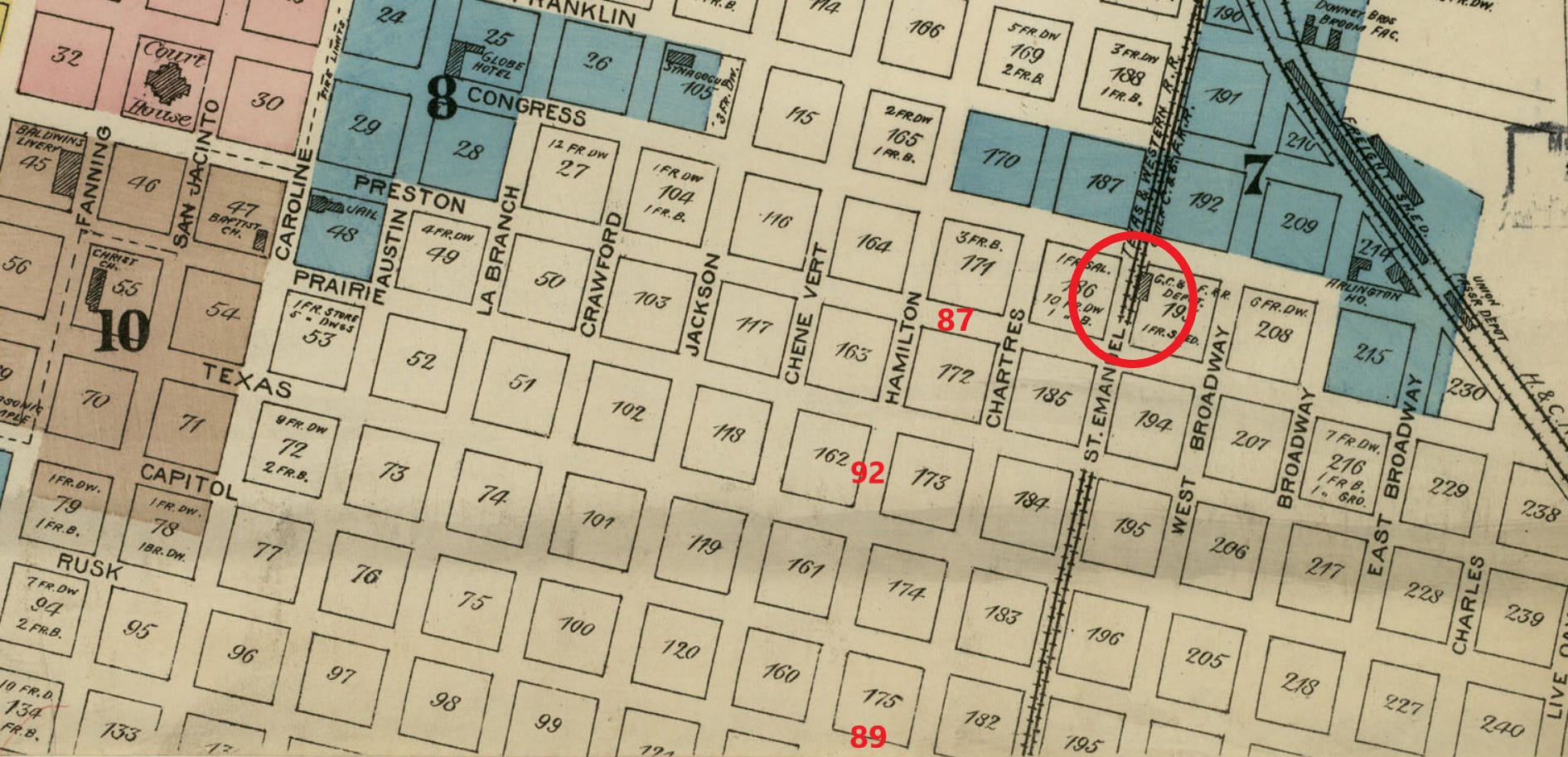
Image 2. Approximate locations of the Saunders residence in 1887 (87), 1889 (89), 1892 (92), and his first Houston workplace at the Gulf, Colorado & Santa Fe Freight Depot (circled). Image source: 1885 Sanborn Map of Houston, Key Map, Perry-Castañeda Library Map Collection, University of Texas Libraries. Annotated by author.
However, in 1892, Saunders was working at the Houston and Texas Central freight depot on Washington Avenue at Fifth Street, adjacent to Grand Central Station, near a location many Houstonians of today would recognize as the POST Houston, nestled near the elbow of White Oak Bayou that forms its mouth at Buffalo Bayou. The Saunders family moved once again, though remaining in the Third Ward at 608 Hamilton Street (at Texas Avenue). This would have been a commute of just over a mile. Did Saunders walk, ride a bicycle, or ride a streetcar?5
The changes of residential location for the Saunders family in 1887, 1889, and 1892 were not very significant. They did not leave their neighborhood within the Third Ward during this five-year period. What was a significant change for Saunders, however, was accepting a job at a remote location, north of Buffalo Bayou. In 1887, when he first worked in the neighborhood at the Gulf, Colorado & Santa Fe Railroad, Saunders was close enough to home to possibly return for meal breaks. By 1892, Saunders joined the growing ranks of Houston commuters. This leaves open the question of transportation mode, though. Safety bicycles were sold in Houston, and with various cyclists riding for recreation, these machines would have been visible. Perhaps Saunders bought a bicycle and rode about a mile each way to the Grand Central depot. Even with Houston’s poor street conditions, this was a manageable bicycle commute. The other option was a streetcar commute. Saunders resided just two blocks south of the Congress, Preston and Main route. With a one block walk, a rider could transfer to the Glenwood route, with direct service to the Houston and Texas Central Railroad (HTC) depots. The principal streetcar franchise, the Houston City Street Railway Company had established mulecar service for the Glenwood and the Congress, Preston and Main routes by the 1880s, and these were both electrified in 1891. Perhaps the electrification of these two routes made commuting to Washington Avenue more attractive (Image 3).6
There is no direct evidence for Saunders’ specific duties with the Houston & Texas Central; however, the most common purpose of railroad telegraphy was its place within the dispatch chain. Relaying train orders was a railroad telegrapher’s most important duty. This consisted of receiving inbound messages in Morse Code while transcribing them to paper; and reversing this process for outbound messages. Meanwhile, during part of his tenure with HTC, he also received weekly weather reports from the state meteorologist in Galveston via telegraph, transcribed these, and reported them to the Houston Daily Post.7
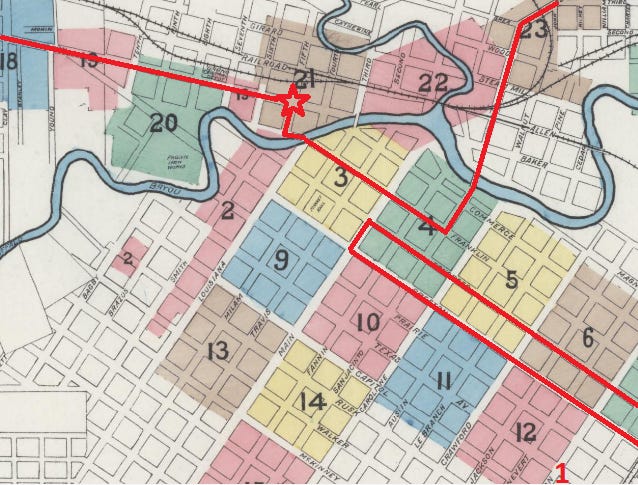
Image 3. Approximate locations of the Saunders residence in 1892 (1) and his workplace at the Houston and Texas Central Railroad Depot (marked by the star). The red lines depict the best electric streetcar routes available in 1892 between the Saunders residence and workplace. Image source: 1890 Sanborn Map of Houston, Key Map, Library of Congress. Annotated by author.
Saunders relocated within Houston for the last time around 1894. He moved into a detached house at 1911 Bell (Image 4), which was several blocks more distant from the HTC freight depot, implying a commute of almost two miles. It’s difficult to imagine that a fifty-year old man would move further from work with the idea of walking as the default mode. He must have been commuting via bicycle or streetcar. While there is no previous documentation of non-recreational cycling in Houston during the 1890s, bicycle clubs existed in Houston, as well as shops which sold and repaired bicycles.8
David Robert Saunders and Benjamin Earnest Saunders (about 19-years-old in 1894) could have been bicycle commuters or streetcar commuters. As late as 1896, none of the streets in their neighborhood were paved and most streets in Houston still lacked pavements. Frequent heavy rains in Houston would have rendered the unpaved surfaces to mud, making the bicycle an unreliable form of transportation for commuting. The 1896 Sanborn map depicts the Saunders’ homestead as a single-story frame dwelling with three outbuildings on a large key lot. One of the outbuildings is classified as a stable (Image 4). All of the lots on this block were developed as residential properties. Assuming that Block 308 was platted to the Houston standard of 250 feet square, the Saunders property measured fifty feet in width with a depth of 125 feet. The Aransas Pass streetcar line serving the Third Ward (Image 5) was electrified in 1892, and it was just a two and a half block walk to Jackson Street, giving Saunders dependable public transportation via transfers to the Main Street line and the Glenwood line to his job at the HTC depot.9
By 1895, Saunders listed his occupation as clerk. He still worked for HTC. Earnest worked in the engineer’s office of the HTC and resided with his parents at 1911 Bell.10
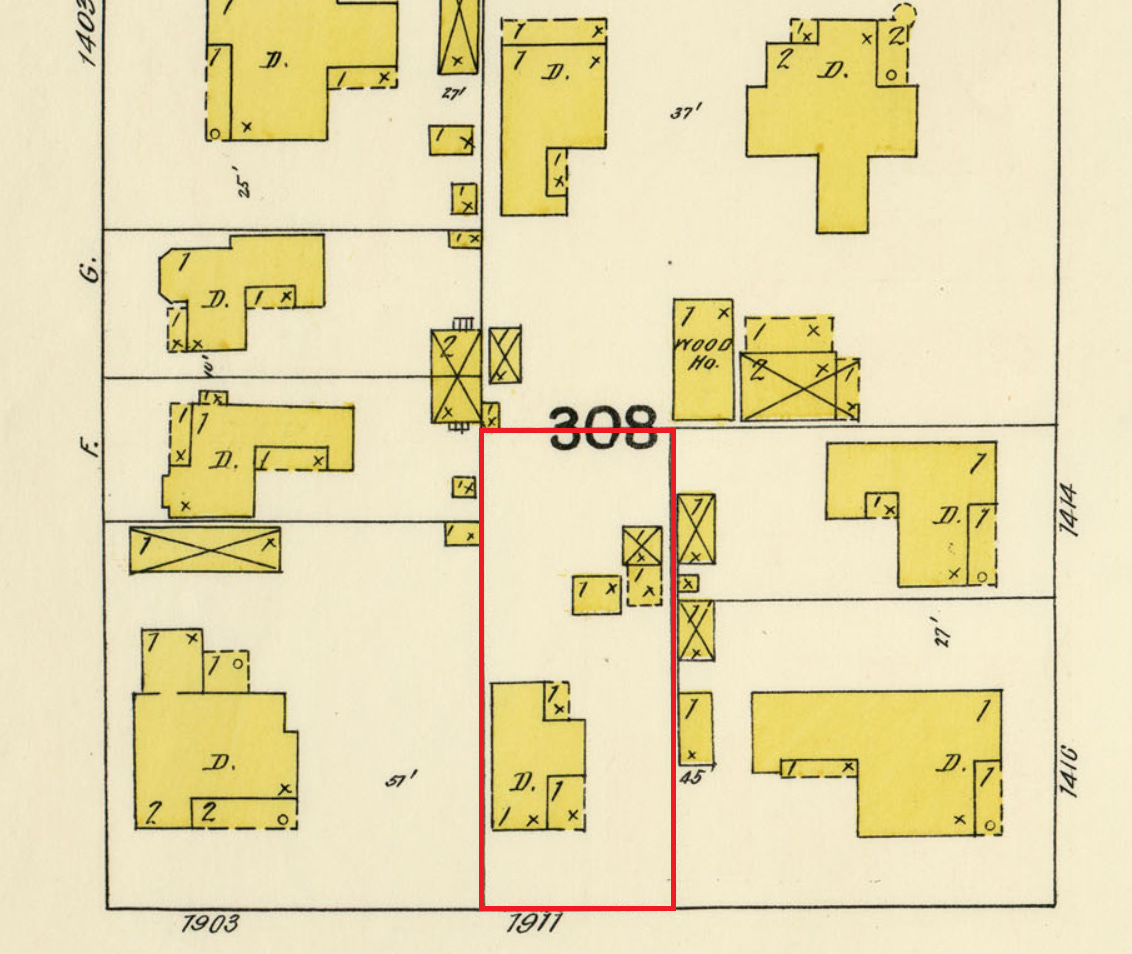
Image 4. The Saunders homestead at 1911 Bell at the outskirts of the Third Ward, their final place of residence in Houston. Image source: 1896 Sanborn Map of Houston, Key Map. Perry-Castañeda Library Map Collection, University of Texas Libraries. Annotated by author.
Keep reading with a 7-day free trial
Subscribe to What Are Streets For Newsletter to keep reading this post and get 7 days of free access to the full post archives.