
Differing Historical Perspectives on the Walking City
Warner, Wade, Jackson, Melosi, Gordon, Blackmar, Shammas, and Hayes

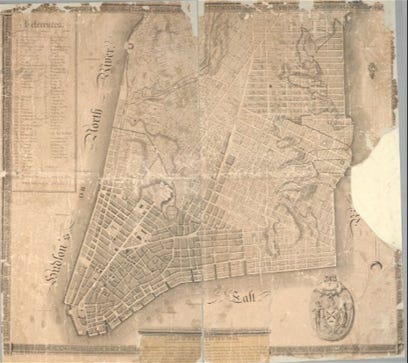
Image 1. Casimir Goerck, surveyor, “Plan of the City of New York,” 1803. Image source: New York Public Library Digital Collections.
Sam Bass Warner, Jr invoked the notion of the “walking city” in Streetcar Suburbs. For Warner, the footprint of the city was most relevant. Warner cited the compact city of Boston and its compact radius of two miles in 1850. In the subsequent decades, however, emerging communications technologies extended the range of residents, reducing the need for walking and in-person communications. Range was also limited by the geography of Boston, which was bound by water and hills.1
Yet none of the characterizations above of the walking city define it:2
One can only guess just how large metropolitan Boston would have grown had there been no invention of new communication devices. If the spread of the city had begun to exceed the distance a man might walk in about an hour, say a three-mile radius, the shops and the offices of the metropolis would have fallen out of easy daily communication with each other. The result would have been the destruction of a single unified communication network and the development of semi-autonomous subcities which would have had to duplicate many of the services and facilities offered in other parts of the city. One of the principal contributions of nineteenth century transportation and communication technology was to preserve the centralized communication of the walking city on a vastly enlarged scale. [bold added]
From the quote above, we can tease out Warner’s definition of the “walking city.” Warner imagines the defining function of the city as the persistent business communications between all of its nodes, operating according to some centralized system. So the walking city is merely the centralized communications of the city bound by the geographical imperatives of walking and face-to-face contact.
Richard C Wade, another pioneer in urban history, also considered the walking city:3
The eighteenth- and nineteenth-century American city, however, was quite different from the modern metropolis. It was most importantly a compact city. The rich and poor lived close together; residential and commercial uses of land were mixed; industrial facilities were located amid shops and homes. It was a ‘walking city.’ The boundaries were determined by the distance one could walk—to work, to shop, or to visit. This limitation governed both the size and the shape of the early city.
Kenneth T Jackson, like Wade, generalized the walking city without focusing on a particular example, and devised five characteristics: congestion, sharp edges between town and country, mixed land use, short commutes, and central locations being the most desirable. Martin V Melosi offered an alternative quintet of characteristics: compact footprints, houses combined as workplaces and residences, short journeys, mixed land use, and central areas reserved for elites.4
David Gordon and Betsey Blackmar anticipated Jackson’s and Melosi’s centralized land value observation, while using it as their central critique of Warner: “David Gordon [and others], have refined the concept of the walking city by noting that because of the differentiation of land values, classes settled in different areas of the city, thus revealing spatially the economic stratification of mercantile society.”5
In 2000, Carole Shammas challenged Warner’s model of the walking city indirectly in “The Space Problem in Early American Cities.” US population concentrated in a few major seaport cities between 1790 and 1830, even while the footprints of these settlements barely expanded. In 1800, most US settlements had small populations and small footprints, when the average population density was six persons per square mile. By contrast, the seaport cities of Baltimore, Boston, New York, and Philadelphia jammed large populations footprints similar to those of much less populous settlements. New York and Philadelphia each boasted populations per square mile of over 40,000.6
However, Shammas was unsatisfied with the conventional explanations for the small footprints of these seaport cities. She pointed out that London, a more populous city than any city in North America, was less dense.
Samuel P Hayes offered “pedestrian communities” as an alternative to the walking city:7
Prior to industrialization, cities had been relatively small, compact and integrated. They were ‘pedestrian communities’ in that the location of activities was determined by the time it took to walk between them, between residence and occupation, church and school, store and recreation facilities. The community tended to be a face-to-face community, in which human relationships were established by personal contact over limited areas. These relationships were close. Individuals could not live free from the view of others, from their approval or disapproval. In such a social situation, those who became dominant in economic, social, and religious life established and maintained acceptable patterns for the entire community. Differences in values which might lead to differences in public demands were not readily revealed in political affairs.
Does Hayes offer “pedestrian communities” as a competing concept to the “walking city,” or is this just alternative terminology? While Warner stressed the importance of the need for all nodes of a walking city to be interconnected, Hayes omits this requirement. When Warner objects to “subcities”; that is, to the duplication of services in different parts of the city, he is merely dismissing urban neighborhoods by another name. The proximity of goods and services to where people live should be the defining characteristic of an urban neighborhood.
Sam Bass Warner, Jr., Streetcar Suburbs: The Process of Growth in Boston, 1870‒1900 (Cambridge: Harvard University Press, 1978), Second Edition, 15‒21. Concurring is Richard Legates, “Walking City,” in Encyclopedia of the City, Roger W. Caves, ed. (London: Routledge, 2005), 515–6.
Warner, Streetcars Suburbs, 15‒6.
Richard C. Wade, “Urbanization,” in The Comparative Approach to American History, ed. Vann Woodward (New York: Basic Books, 1969), 191.
Kenneth T. Jackson, Crabgrass Frontier: The Suburbanization of the United States (New York: Oxford University Press, 1983), 14‒5; Martin V. Melosi, “From ‘Walking Cities’ to ‘Automobile Cities’,” in The Automobile Shapes the City, Automobile in American Life and Society.
Betsy Blackmar, “Re-walking the ‘Walking City’: Housing and Property Relations in New York City, 1780–1840,” Radical History Review 21 (1979): 131[quoted]–48; David Gordon, “Capitalism and the Roots of Urban Crisis,” in The Fiscal Crisis of American Cities, Roger E. Alcaly and David Mermelstein, eds., (New York: Vintage Books, 1977) 82–112, especially 99–100.
Carole Shammas, “The Space Problem in Early American Cities,” William and Mary Quarterly 57, no. 3 (July 2000): 505–42.
Samuel P. Hays, “The Changing Political Structure of the City in Industrial America,” Journal of Urban History 1 (1974): 8–9.