

Posts on the History of Sidewalks
Abutters’ Responsibilities for Streets and Sidewalks in Ancient Rome
History of Sidewalks: Introduction
Translation of “Les Trottoirs de Pompéi: Une Première Approche” by Catherine Saliou
History of Sidewalks: Antebellum Houston

Introduction
In present-day Houston, as with many cities, the responsibility for sidewalk maintenance lies with the abutting property owners, but maintenance of the part of the street between the curbs (carriageways) is financed by the local government drawing from general revenue. Where did this come from? Let’s call this the Double-Standard of American transportation finance.
For my purposes, a sidewalk is a relatively narrow, paved walkway running parallel to a roadbed or carriageway. A sidewalk is part of the right-of-way. Historically, there is not always a means for determining whether Houston’s sidewalks had lain on private or public property, and this uncertainty is examined below. This essay treats sidewalks as street elements, thus as part of the street and not something separate from it. The carriageway will refer to the part of the street where vehicles are allowed to travel.
This kind of Double-Standard did not apply to Houston before the Civil War. On the contrary. During this period, sidewalks were treated favorably compared to carriageways by property owners, storekeepers, the City Council, and the newspaper editors. From its founding, some Houston property developers constructed plank sidewalks on their own initiative. Later, the city mandated sidewalk construction and maintenance without a similar mandate for carriageways; to wit, there was a double standard in favor of sidewalks. However, there is evidence for a possible shift in opinion when the editor of The Weekly Telegraph advocated for a more comprehensive program for municipal street improvements in the late 1850s.
Sidewalks, when they existed, played a different role within the pre-industrial street compared to their role within the context of the modern street. For the purposes of this study, all streets prior to the construction of Pont Neuf during the reign of Henri IV are assumed to be pre-industrial streets. So Pont Neuf represents the first modern street.
Houston has a long history of sidewalks. Even some covered sidewalks persisted along the main blocks of the business district throughout most of the nineteenth century. For the storekeepers, a sidewalk, especially under a colonnade, was an inducement for passers-by to inspect the stock in their windows. For pedestrians, contemporary concerns were mainly a refuge from the muddy and tripping hazards in the carriageway.
Republic of Texas, 1837-1845
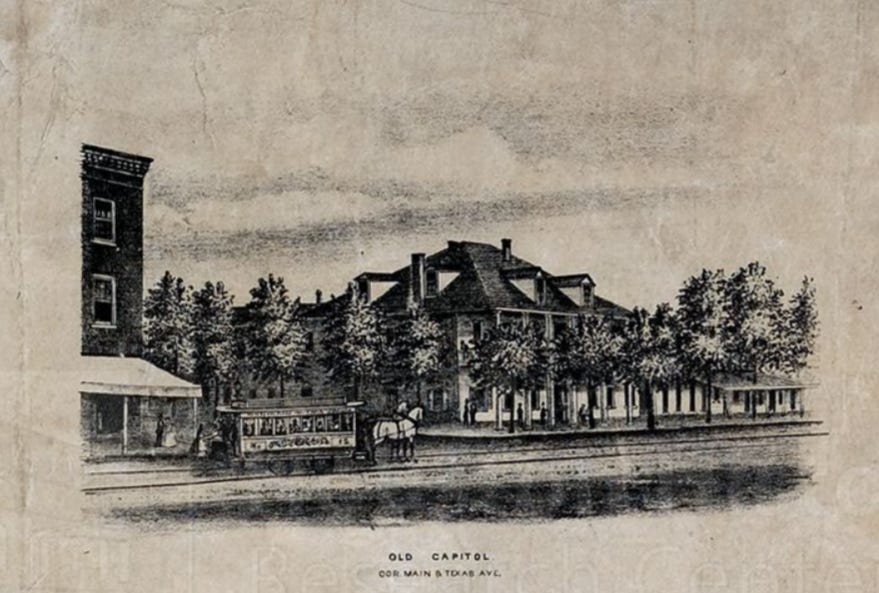
There are two buildings that probably had sidewalks early in 1837. Houston’s founders, AC and JK Allen contracted with Thomas William Ward to construct two buildings on Main Street: the Capitol and the Long Row. The Allen brothers selected Lots 1 and 2 in Block 57 for the façade of the Capitol site, a location better known as the northwest corner of Texas and Main. The Allen brothers also devised a backup plan for a Congressional venue. They also directed Ward to build the Long Row (aka Mercantile Row), a single-story building to run the entire western block face on Main Street between Congress and Preston. For the Capitol, Ward probably ordered white pine, imported from Maine. Possibly, the Allens were willing to accept lower quality lumber for the Long Row, which would explain why Ward built the Long Row before the Capitol. The Heritage Society at Sam Houston Park constructed a replica of the Long Row and now use it for their administrative offices. The replica includes a covered plank sidewalk. I have not yet given careful consideration to the evidence for covered plank sidewalks at the Long Row. Unlike, the Long Row, there is an extant building contract for the Old Capitol. The contract did not specify a raised plank walkway, but it did call for two galleries with railings atop balustrades. This detail in the contract is consistent with various artistic depictions of the site. Neither the contract nor the artists’ representations of the Old Capitol reveal whether the the double gallery was located. Was it behind or beyond the property line? As I have defined it, a sidewalk is a public corridor. Second, enclosure prevents a sidewalk. A functional sidewalk should allow for a continuous path along the facade of the building for the entire length of the property. The hand railings and balustrades prevent this. Therefore, the Old Capitol did not have a sidewalk. So Houston’s first sidewalks were probably constructed no later than late-April of 1837.1
Therefore, it’s possible that there has been a sidewalk in Houston almost as long as there has been a Houston. However, this still raises the question of how important sidewalks were as a part of the urban landscape. The Texas Congress granted Houston and several other towns and cities their first charter on 5 June 1837, which was attached as an amendment to a bill to incorporate the town of Nacogdoches. Municipal authority was narrow in scope, but it did include, the power to regulate the police, levy taxes for addressing nuisances, and “keeping the streets in order, and prescribing the penalties.”2
According to Kenneth Wheeler, in 1839, the City of Houston was already regulating minimum sidewalk width, drainage, and awning height. Houston City Council raised the issue of protecting pedestrians on sidewalks as early as March 1839. A local newspaper published an early sidewalk ordinance, “Resolved, That the Committee on Streets and Side-Walks be required to report [on] an [Ordinance] for the purpose of [preventing] the passage of horses and carriages upon the Side Walks of this city and to report to the next meeting of the Board.”3
Municipal records for Houston City Council ordinances are not extant for 1839, so we rely on secondary sources such as newspapers and memoirs. I have not found any corroborating evidence of a meeting of the Committee on Streets and Side-Walks, nor of the passage of any kind of sidewalk ordinance in 1839. Even lacking evidence of the passage of such an ordinance, it is somewhat interesting that Houston City Council at least considered drafting a sidewalk ordinance during the first few years of the Texas Republic. Furthermore, the wording of the council’s resolution implies some sidewalks existed in Houston as early as 1839. Yet it also reveals that sidewalks had not yet been legally defined as space reserved only for pedestrians. A second council resolution, however, proposed a prohibition against horses and carriages on sidewalks. Why did members of council think such an ordinance was necessary?4
What problem was this resolution supposed to be addressing? The earliest sidewalk in Houston were most likely the raised plank ways under colonnades attached to the Long Row, both constructed during the first half of 1837. Did other shopkeepers make pavement out of other materials, such as shell, stone, or brick? If these other sidewalks were not raised, it might explain why there might be a need to create an ordinance prohibiting horses and carriages. Another possibility would be vehicular crashes. Perhaps an ordinance was necessary to establish a basis for fault against vehicular operators and animal keepers who crashed into colonnades.
According to Wheeler, abutting property owners were responsible for cleaning sidewalks and gutters. By 1839, parts of Main Street had sidewalks clad with brick. Around 1841, Houston expanded the sidewalk mandate to standards for quality and size.5
There is at least one instance of a property owner complying with the sidewalk mandate. Presumably, Mr DePew built a sidewalk in from of his stable “by completing a firm, dry walk.” A Houston newspaper editor approved, “Will other property holders go and do likewise,” suggesting that DePew was an exception early in 1841.6
Within a few weeks, however, a rival newspaper reported more activity:
Our merchants along Main street are filling up and sanding the side walks, and we shall soon have a dry promenade to the bayou. We have observed within a few days, several of the crossings raised and sanded, and we have no doubt but in the course of another year we shall be able to walk in any part of the city without having to wade ankle deep in mud, “a consummation devoutly to be wished.”7
In at least one case, the city identified a sidewalk in urgent need of repair and order that the city fund the project at the corner of Franklin Avenue and Travis Street. A third newspaper in 1841 reported and opined on sidewalk construction. The editor of Morning Star reported a sidewalk standard of seven feet for Main Street, but based on the foot traffic, recommended sidewalk width be expanded to twelve feet on each side of the street. The editorial also anticipated a plan to plant trees on Main Street.8
Antebellum Statehood, 1845-1861
EH Cushing published an opinion piece in 1857 advocating for better sidewalks and drainage for Houston streets. Cushing expressed disgust about mud in the streets, or “sloughs of despond,” especially since muddy streets offended women and visitors. However, what was different in Cushing’s entreaty was its scope: he urged the city to install sidewalks on every block. During the Republic, the onus of street improvements usually fell on retail property owners, and storekeepers favored improvements to sidewalks over carriageways. With abutting property owners paying for improvements, sidewalks followed a logic according to their preferred land use and self interest. Sidewalks drew passers-by to property lines and made these liminal corridors more public, which probably was probably not a priority for owners of homesteads.9
Earlier appeals by Cushing for sidewalks as safe havens from the mud were later replaced by admissions the following year that mud followed pedestrians to the sidewalks during spells of rainy weather. Nonetheless, he continued to press for general street improvements, while proposing sidewalks citywide. He alleged that Galveston already had such a sidewalk program.10
An editorial from the Weekly Telegraph supported the new sidewalks, “We are glad to see that our citizens who reside or do business on Main street, and the blocks fronting thereon are quite generally engaged in laying down brick side walks, in accordance with the ordinance to that effect. The improvements thus made it a first rate one.”11
A week later, the editor averred, “We are pleased to notice the improvements about court house square. The substantial brick side-walks leading to the court house are just the thing,” while offering the following prospective view:
Strangers passing along our sidewalks in the evening just now, are apt to censure the corporation worse than the property holders do, for the ordinance requiring the pavement of the Main street sidewalks. But let them hold their temper. A few weeks will finish the work, when pedestrians will bless the memory of the men who established the improvement. Sprained ankles will then be forgotten. People will then be able to pass from the Old Capitol to the boat, and gaze at all the lions along the way, without having to look at every footstep that they don’t break their necks in the holes.12
The ordinances and the editorials are telling. The investment in pavements prioritized pedestrian access over vehicle access. Brick, stone, and tile were expensive pavements compared to the oyster shells that paved Main Street. If the editorials from the Republic can be trusted, there was significant initial compliance with the sidewalk pavement ordinance. City Council passed the ordinance on 13 May and the Weekly Telegraph reported construction in progress in some places, and completed sidewalks in other places within two months. Yet it is also apparent that a voluntary system depending solely on the cooperation of abutting property owners could only deliver partial compliance, even though the City of Houston was more successful with forcing compliance with sidewalk construction on Main Street. In the late 1850s, the editorials by EH Cushing were reflective of rising expectations for street infrastructure. Cushing proposed a more comprehensive approach to street improvements compared to the sidewalk program of the Republic. He recommended that all streets within the city be improved and he did not limit his proposal to sidewalks. Cushing stressed drainage as well as sidewalks, but also called for paving carriageways. What did not change, however, was the relative importance of sidewalks compared to carriageways.
How long would it take to install sidewalks today? Where would the quality of materials in sidewalk pavements exceed those of the carriageway?
For the best secondary source on the construction of the Capitol and the Long Row, see David Humphreys, Peg Leg: The Improbable Life of a Texas Hero, Thomas William Ward, 1807–1872 (Denton, Texas: Texas State Historical Association), 47-50; Jon Boyd, “The Founding of Houston: The Allen-Baker Partnership,” 23 January 2026, What Are Streets For (paid tier). For Mary Austin Holley’s pencil sketch, see Joe Holley, “Stephen F. Austin’s favorite cousin was accomplished in her own right,” 16 March 2018 Houston Chronicle.
H. P. N. Gammel, compiler, The Laws of Texas, 1822- 1897, Volume 1, (Austin: The Gammel Book Company, 1898), 1298 [quoted]–9 ; Kenneth Wheeler, To Wear a City’s Crown: The Beginnings of Urban Growth in Texas, 1836-1865 (Cambridge: Harvard University Press, 1968), 49.
Wheeler, To Wear a City’s Crown, 54; Telegraph and Texas Register (Houston), “Proceedings of the City Council of the City of Houston,” 13 March 1839, Portal to Texas History [quoted].
Telegraph and Texas Register (Houston), “Proceedings of the City Council of the City of Houston.”
Wheeler, To Wear a City’s Crown, 54.
The Morning Star (Houston), 16 January 1841, Page 2, Column 2 [quoted].
The Musquito (Houston), 7 February 1841, Page 2, Column 2 [quoted].
The Musquito (Houston), 14 February 1841, Page 2, Column 2; The Morning Star (Houston), 13 March 1841, Page 2, Column 1.
The Weekly Telegraph (Houston), “Sidewalks and Drains,” 7 January 1857, Portal to Texas History.
The Weekly Telegraph (Houston), 13 January 1858, Page 2, Column 5, Portal to Texas History; The Weekly Telegraph (Houston), “Our Streets,” 17 February 1858, Portal to Texas History.
The Weekly Telegraph (Houston), 7 July 1858, Page 1, Column 3, Portal to Texas History [quoted].
The Weekly Telegraph (Houston), 14 July 1858, Page 2, Column 1 [quoted].