
Houston's First Hotel: Introduction
The City Hotel, 1837-1859

This is the first of a series on the City Hotel, the first hotel in Houston. The other parts will be published later in 2026:
Houston’s First Hotel: Introduction
Houston’s First Hotel: Elisha Floyd
Houston’s First Hotel: Levenhagen & Company
Houston’s First Hotel: Thomas Benjamin Jefferson Hadley
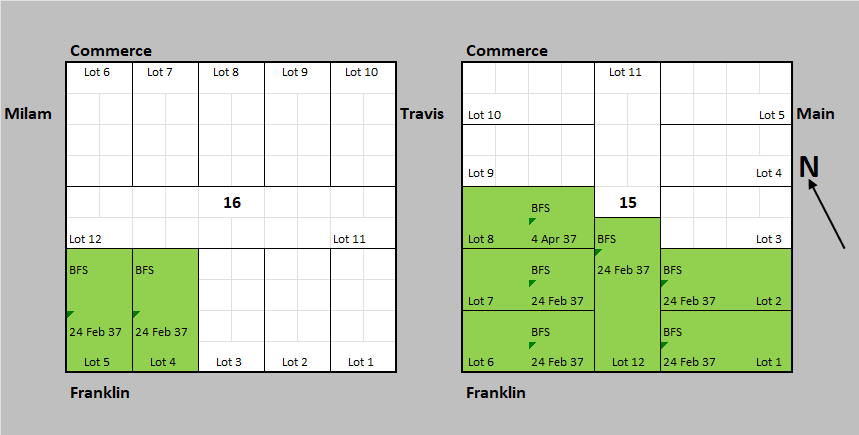
Image 1. The eight lots (shaded) purchased by Benjamin Fort Smith (BFS) in 1837, known here as the City Hotel property. These occupied Block 15 and Block 16, with the first hotel building constructed on Block 15, Lot 6. The dates represent the contract dates for the lot purchases. Map by author.
Introduction
The City Hotel was the first hotel to open in Houston. It operated under different property ownerships and under various tenant proprietors beginning in 1837 until the last remnants of the hotel were demolished in 1859. Although the history of the City Hotel is still fragmentary, this series represents the deepest and most comprehensive account of Houston’s first hotel. There are no surviving plans or drawings of the hotel, but there are a few brief accounts by a few of the guests. The best interpretation of the physical hotel is derived from deed records, advertisements, and memoirs. Contrary to the use of hotel to describe hospitality venues with distinctive, elevated architecture and high standards of service in major cities of the US, all accounts of the City Hotel imply modest accommodations, at best. In this sense, the City Hotel is not a true hotel according to the historiography. The City Hotel, however, shared some important characteristics with the cutting edge hotels of American cities: its role as a local landmark and as a neighborhood and municipal hub of communications, and social and business activities.
The majority partners of the Houston Town Company (HTC), Augustus Chapman Allen (aka “A. C.” and John Kirby Allen (aka “J. K.”), promoted the aspirational town of Houston as the next temporary capitol. A successful sales pitch required convincing the Texas Congress that a town existed, or at least would exist, when the second session of the First Congress was scheduled to convene on 1 May 1837. In addition to a government building, a capitol city required housing, food, and a variety of goods and services to sustain temporary and permanent residents of the icty. When HTC sold the first Houston lot on 1 January 1837, there were just a handful of shacks and tents. Houston was not a townsite; it was a campsite. On 30 August 1836, the Allen brothers promised a “public house” in their notorious first advertisement placed in the (then Columbia, Texas-based) Telegraph and Texas Register. This proves that HTC understood their situation: sustaining a fledgling government and its entourages required housing, whatever the type. This was not just a matter of providing shelter, it was also a matter of providing meals. The de facto capitol of Columbia failed to provide enough accommodations for people requiring room and board, which was the main reason that Columbia was deemed inappropriate, even as a temporary capitol. Therefore, HTC—a subdivider—aspired to profit from the sale of town lots, while providing some amenities. On the other hand, third parties developing these amenities, such as public houses, also enhanced the value of neighboring undeveloped lots.1
Without accommodations for room and board, town lots held little immediate use. The faster some of the lots could be developed, the faster unsold lot values would rise. Yet, as much as Allen brothers promised development, HTC only surveyed land and subdivided lots. However, the Allen brothers speculated on Houston land on their own accounts and they also formed partnerships outside HTC.
The City Hotel story is important to understanding early Houston. Hotels were important for their locations. They were most often located in the most desirable neighborhoods; that is, they were located near other real estate development or where other real estate development was expected to take place. In turn, hotels attracted economic activity. As a living arrangement, meals were provided to its residents as part of room and board, while resident boarders often chose a hotel based on its proximity to their jobs (or chose their job by its proximity to their hotel). Similarly, professionals used hotels as a work-home arrangement. Examples of this include attorneys, physicians, and land agents. It is not known whether resident professionals used their personal rooms as offices, leased office space in the hotel, or simply arranged business meetings in common areas; however, they published their business contact information using the City Hotel as an address.
Hotels in Houston were also hubs and nodes of local and extra-local communications. Hotels often kept reading materials in their common areas, including newspapers, journals, and directories. Hotel locations were known to porters and omnibus drivers, and hotels often had relationships with stable owners, so that guests with their own vehicles and livestock could receive attention, and horses and rides could also be hired.
The City Hotel raises questions about persistence in the business. Most hotels in Houston were owned by one party and leased to another party acting as a tenant proprietor operating the hotel. Yet, in the early years of the hotel, ownership turned over very quickly. For some years preceding the acquisition of the City Hotel by TBJHadley, it is not known who was running the hotel, though it was evident that all of the previous owners had defaulted on their debt.
The Benjamin Fort Smith Hotel
Benjamin (“Ben”) Fort Smith (1796-1841) was born in Christian County, Kentucky on 2 January 1796. He was one of eleven children born to David Smith (1753-1835) and Obedience Fort Smith (1771-1847). Ben Fort Smith was a veteran of the Texas Revolution. He moved his mother from MS to the Republic of Texas. He also moved an elder sister, two younger sisters, and two younger brothers to Texas. Their first homestead in the Houston area was located on the Old San Felipe Road (present-day West Dallas) at present-day Polk Street.2
Keep reading with a 7-day free trial
Subscribe to What Are Streets For Newsletter to keep reading this post and get 7 days of free access to the full post archives.