
Transportation Efficiency
Using the least mobility to get the same results

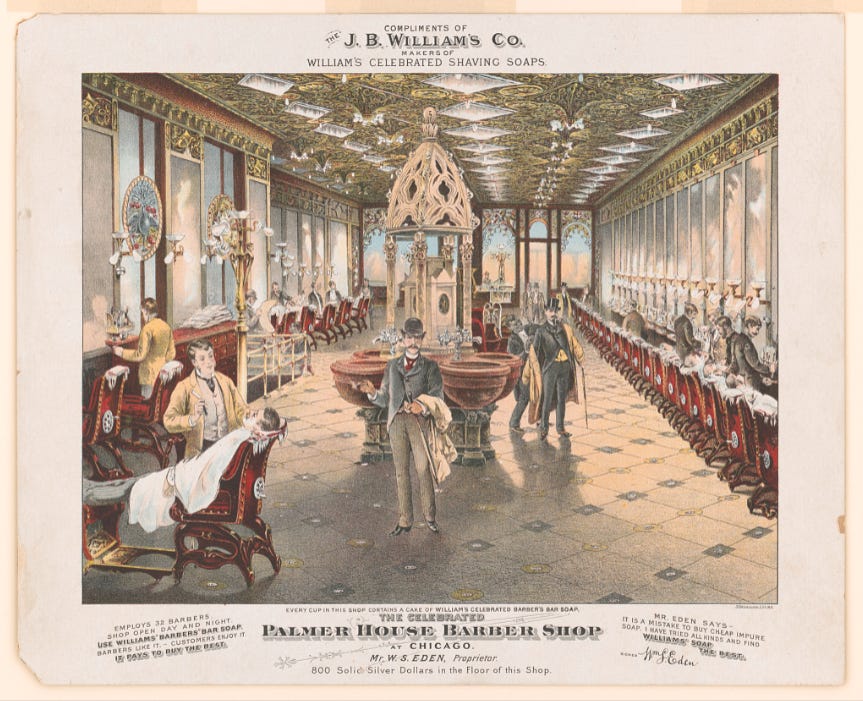
Image 1. J. Ottmann Lithography Company, “The Celebrated Palmer House Barber Shop,” 1887. Image source: Library of Congress.
Efficiency means getting the best results relative to the resources employed for the project. Thus there are two kinds of efficient outcomes: using the same amount of resources for an improved outcome or a reduced level of resources to produce the same outcome. There are both quantitative and qualitative aspects to efficiency. An improvement in efficiency in widget production could be purely quantitative if a new machine were to improve production by ten percent, provided that widget quality were at least as good as before the machine. In short, efficiency improvement should be distinguished from reduced production or degradation of quality.
A quick internet search does not reveal any direct interest in the concept of transportation efficiency; however, there is a great interest in energy efficiency in transportation. These two concepts are closely related, but transportation efficiency should be preferred as a first-order problem, while energy efficiency in transportation would logically follow from the first. This piece examines transportation efficiency as getting the most from the least mobility.
Efficiency in Mobility
Transportation planners normally think of their mission as maximizing or optimizing for mobility. This is true for both the devotees of highways and other automobile-based transportation solutions, and the increasing number of younger planners who propose active transportation solutions. Mobility is a quantifiable variable: it can be measured in terms of vehicles, people, freight tonnage, and distances.
Freight
While a traffic engineer imagines efficiency in terms of throughput and level-of service, a freight planner imagines efficiency as a cost problem. If the problem of transporting freight over long distances were simply moving it on the fastest mode possible, it would all move on aircraft, which is by far the most expensive mode of freight transportation. Freight does not usually move on the fastest conveyances. Trucks are slower and less expensive than planes, and trains and barges are slower and less expensive than trucks. The higher the level of mobility, expressed both in terms of distance and speed, the greater the resources required and the higher the monetary cost. So freight transportation efficiency requires reducing distances where possible and reducing speed where possible. An example of reducing distance would be a cartage company locating near a railyard or a port to shorten the distance of its trucks to pick up at the location of a primary freight customer. An example of reducing speed would be a shipper transporting freight by barge or rail to a warehouse located near a customer. This allows the freight to move slowly and economically over distance, while it is being staged for fast last-mile delivery by truck. These practices are efficient if they are cost-controlled while still meeting the standard set by the customer.
Passengers
Transporting people is the far more difficult problem. Freight can often be compressed, stacked, and palletized. Most freight does not require temperature control. Transportation of people must be humane. People require measures of safety and comfort. Unlike freight, people can choose the way they travel. Therefore, when transportation is in fact safe and comfortable, planners and other public officials must articulate that it is safe and comfortable in a convincing way.
Efficiency within an Access-Based Paradigm
At least one transportation planner has agitated for an access-based revolution in transportation planning. This means that transportation planners should optimize for access. In 2015, Todd Litman expressed this revolution in Kuhnian terms. Reordering transportation as an access problem is a paradigmatic change, analogous to the Copernican paradigm of heliocentrism replacing geocentrism. The advantage of access-based paradigm is most palpable as applied to the transportation of people, who have moral agency, thus are able to make choices where they want to be and what need they are trying to fulfill. Access concerns itself directly with fulfilling needs while mobility is its own end.
Optimizing land use for access facilitates transportation efficiency as understood within an access-based paradigm. An example of such a practice in freight logistics is a cartage company locating its truckyard near a railhead or a packaging warehouse that it serves. This minimizes deadhead (the distance traveled without revenue-producing freight). This is the basis of walkable neighborhoods. By locating or at least allowing for the location of complementary land uses within the same neighborhood, people can walk as a means of practical transportation. Residences located near grocers, drugstores, restaurants, hardware stores, physicians, and hair stylists require less mobility since they can serve many of their needs with short walks.
Every human eats, drinks, and eliminates waste. These three activities are not optional and they are frequently occurring needs. Regarding food access, a common strategy is buying stores of food and keeping them in refrigerators and pantries. In this way, we need only to move within our own residences to access food. That’s peak transportation efficiency: access to food is achieved with minimal movement. Yet there is a prior step required to facilitate food access; that is, transporting food to residences. In pre-modern times, access to food was a managed with slow mobility and proximity. Taverns and hawkers sold ready-to-eat food within neighborhoods. Lacking refrigeration, daily grocery shopping was necessary to supply food stores for those who cooked at home. This was accomplished by shopping at the public markets, which conferred an advantage in access to those who resided or set up businesses adjacent to those. Private neighborhood grocers supplied staples at a higher price while participating in a supply chain that better distributed food throughout a settlement. For higher prices, neighborhood grocers made food more accessible to many people. Hawkers continued to play a role in supplying accessible food into the nineteenth century.
Buildings as Transportation Systems
Even if the term is not in use by architects, buildings are designed for transportation efficiency.
A useful thought experiment is imagining buildings as transportation systems. For example, a dwelling is a system of rooms and private easements. Stairways, halls, and foyers are like streets in the sense that they are easements for the use of the residents and their guests. These are the most “public” areas of the dwelling, and rooms are the places within a dwelling where people linger the most. A kitchen has a pantry and a refrigerator because food storage is most conveniently located where food is prepared. Convenience dictates that toilets and wash basins be distributed throughout the dwelling for access; that is, they should be located in proximity to where people linger the most. Bedrooms are lingering places, and as such, it’s common to attach a bathroom to the master bedroom, allowing a few languid residents to stumble their way to the toilet in the middle of the night.
Hotels have been characterized as “cities within cities.” As Molly W. Berger notes in her study of nineteenth-century, first-class hotels, a wide range of goods and services located within the hotel itself. Hotels provided some of these services directly and leased stores within the hotels to third parties. Amenities included restaurants, separate gentlemen’s and ladies’ parlors, bars, reading rooms, billiard rooms, and barber shops.1
Hospitals are transportation systems. Many hospital clients are temporary residents, and many of them have impaired mobility, even if that’s a temporary condition. Thus hospitals are equipped with rooms storing diagnostic equipment, allowing people to be wheeled to areas with the hospital for testing. There are also mobile diagnostic machines because it’s more efficient to make the equipment slightly mobile than it is to wheel persons around the hospital. Hospital rooms have bathrooms attached. Hospitals have large, institutional kitchens so that orderlies can wheel meals to rooms.
In similar fashion, big boxes, shopping malls, and flea markets have internal transportation systems.
In all of these cases, convenience is facilitated by locating complementary facilities in proximity to each other.
Molly W. Berger, Hotel Dreams: Luxury, Technology, and Urban Ambition in America, 1829–1929 (Baltimore: Johns Hopkins University, 2011), 5-6.
I always like thinking of elevators as public transit like a microbus and escalators and moving walkways as mass transit like a train. It is famously hard to get people out of cars, yet somehow all are willing to park in a garage and hoof it to an elevator for an office job.