
Bridget Gallagher, Boardinghouse Keeper and Grocer
First Ward, North Side Buffalo Bayou

Other Boardinghouse Biographies
Elizabeth E Hay, Boardinghouse Keeper and Boardinghouse Client
Bridget Gallagher, Boardinghouse Keeper and Grocer
The Paulina Rosenfield Boardinghouse
Millie Gray and Her Boardinghouse on Courthouse Square, Houston
Emma Angell, Housekeeper
Henrietta Bottler, Boardinghouse Keeper
The Wilson Sisters, Boardinghouse Keepers
Charles and Marie Kodtler, Boardinghouse Keepers
Bridget Gallagher
A native of Ireland, Bridget Gallagher was married to John G Gallagher and they resided in the First Ward, North Side, Buffalo Bayou (NSBB). Born around 1825, the Gallaghers housed a twelve-year-old girl with the Gallagher surname. Mary Gallagher was born in LA around 1848. Due to the way the census questions were structured in 1860, the relationships of the girl to John and Bridgett are unknown. The Gallaghers also took in three boarders. A common strategy of household economy for working immigrants was taking in boarders as a second source of income. All three boarders were Irish-born, bachelor common laborers. The Gallaghers claimed a personal estate of $1,000, a substantial level of wealth for a common laborer in 1860.1
In 1866, Bridget Gallagher was running a grocery near the Houston and Texas Central Railroad property (Image 2). The long-term prospects for the Gallaghers improved when Mary Gallagher wedded Samuel W Young on 25 February 1868. Young arrived from PA in the 1860s and acquired land on the north bank of Buffalo Bayou where there was a plentiful source of clay suitable for brickmaking. By 1869, Young’s Brickyard was well-established.2
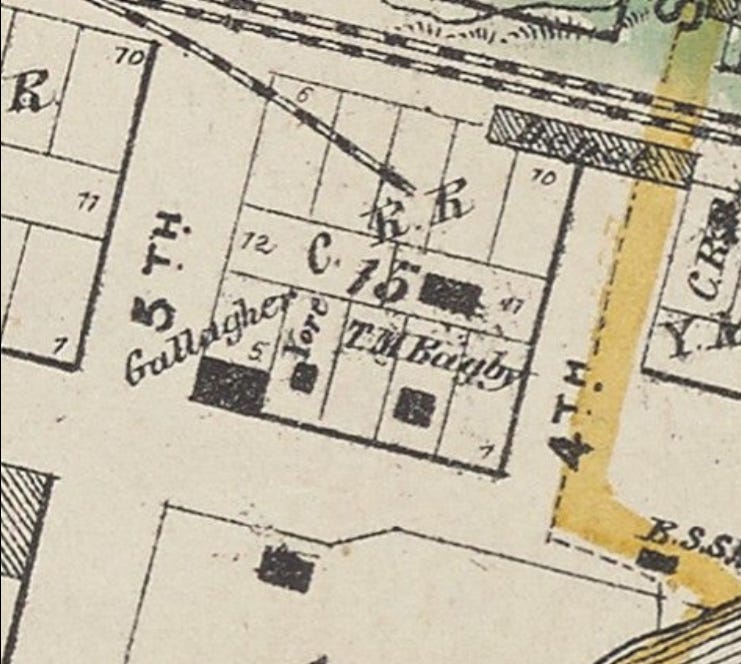
Image 1. W. E. Wood, “The City of Houston,” 1 January 1869. The Bridget Gallagher boardinghouse was located at the northeast corner of Image source: Yale University, Beinecke Rare Book and Manuscript Library, Digital Archives.
In 1870, the location of the Gallagher boardinghouse is more specifically identified as the northeast corner of Washington Road and Fifth Avenue (Image 2). Prior to the 1870 census, however, John Gallagher lost his sight. By that time, he was a resident at the local hospital while Bridget ran her boardinghouse in First Ward, NSBB. Living in the house was a girl named Alice Gallagher, aged six and a native of MI. There were four male resident boarders, aged 26 though 42. Only Charles Smith was a native of Ireland, but two of them were common laborers. The 1870 boarding household shared an important similarity with the 1860 boarding household, but there was also an important difference. In 1860, the Gallagher household had two persons contributing incomes, while only Bridget was working to support the 1870 household. In both cases, there were a small number of boarders who were common laborers.
She invested in Sam Young’s Brickyard and eventually owned it outright. Gallagher was still advertising a boardinghouse as late as 1877, but failed to publish a boardinghouse in 1879. However, the 1880 census records Gallagher living in the same neighborhood with Alice and two boarders. Thomas Gallagher was running a large boardinghouse across the street. In 1882, her directory listing mentioned the boardinghouse and in 1884 was she was operating her house as a grocery and lunch stand. Bridget died on 17 May 1886. Any relationship between Bridget, Alice, and Thomas are unknown.3
Bridget Gallagher was both very ordinary and very remarkable for her time. Gallagher built some modest wealth while working within the social and legal constraints of an Irish immigrant and a female head-of-house. In addition to running a small boardinghouse in the 1860s near the Houston & Texas Central depot, she sold groceries. Yet she was also a small investor in property in Fourth Ward, NSBB. After the disability of her husband, Gallagher was the head-of-house and continued to operate a boardinghouse and grocery, while also taking over Young’s Brickyard.
Eighth United States Census (1860), “Bridget Gallagher,” 30 September 1860, Houston, First Ward, Ancestry [subscription required].
Immigrants as boarders or lodgers: Howard P. Chudacoff, The Age of the Bachelor: Creating an American Subculture (Princeton: Princeton University Press, 2000), 85; Claire P. Dappert-Coonrod and Steven R. Kuehn, “A Boarder, a Widow, and a Tenant Sit Down for Dinner,” Midcontinental Journal of Archaeology, 42, No. 1 (Spring 2017): 11, 13; Wendy Gamber, The Boardinghouse in Nineteenth Century America (Baltimore: Johns Hopkins University Press, 2007), 3, 34-5; Ruth Graham, “Boardinghouses: Where the City Was Born,” 13 January 2013, Boston Globe; Robert F. Harney, “Boarding and Belonging,” Urban History Review 7, No. 2 (October 1978): 8–37; 2013 Mark Peel, “On the Margins: Lodgers and Boarders in Boston, 1860–1900,” Journal of American History 72, No. 4 (May 1986): 817–8; Susan Strasser, Never Done: A History of American Housework (New York: Pantheon Books, 1982), 148; David Ward, Cities and Immigrants: A Geography of Change in Nineteenth-Century America. New York: Oxford University Press, 1971, 108-9.
Boardinghouses based on work connections or trades: Kristin Hoganson, “Cosmopolitan Domesticity: Importing the American Dream, 1865-1920,” American Historical Review 107, No. 1 (2002): 88–9; John Modell and Tamara K. Hareven, “Urbanization and the Malleable Household: An Examination of Boarding and Lodging in American Families,” Journal of Marriage and Family 35, No. 3 (August 1973): 467–8.
Households taking in boarders for second incomes: Jon Boyd, “A Boardinghouse in 1880 Baltimore,” 17 April 2026, What Are Streets For; Stuart M. Blumin, The Emergence of the Middle Class: Social Experience in the American City, 1760‒1900 (Cambridge: Cambridge University Press, 1989), 188, 363n154; Elizabeth S. D. Englehardt, Boarding House Women: How Southern Keepers, Cooks, Nurses, Widows, and Runaways Shaped Modern America (Chapel Hill: University of North Carolina Press, 2023), 60; Gamber, The Boardinghouse, 35; Joan Jenson, “Cloth, Butter, and Boarders: Women’s Household Production for the Market,” Review of Radical Political Economics 12, No. 2 (1980): 14-5, 18-9; Modell and Hareven, “Urbanization and the Malleable Household,” 468.
W. A. Leonard, compiler, Houston City Directory for 1866 (Houston: Gray, Strickland & Company, 1866), 22; 1869 Wood Map; Marriage, Samuel W Young and Mary Gallagher, 25 February 1868, Harris County Texas, Ancestry [subscription required]; William Murray, compiler, Houston City Directory for 1870-71 (Houston: William Murray, 1870) 36.
Age (Houston), “Died,” 20 March 1876, Portal to Texas History; Mooney & Morrison, Directory for the City of Houston, 1877-78 (Houston: Mooney & Morrison, 1877), 101, Houston History Research Center, Digital Archives; 1879 City Directory, 102; It is unclear whether Mary Gallagher was a daughter of Bridget Gallagher and whether Mary was legally married to Sam Young.
Test.