
Houston's First Hotel: The City Hotel Stables
They should be close, but not too close

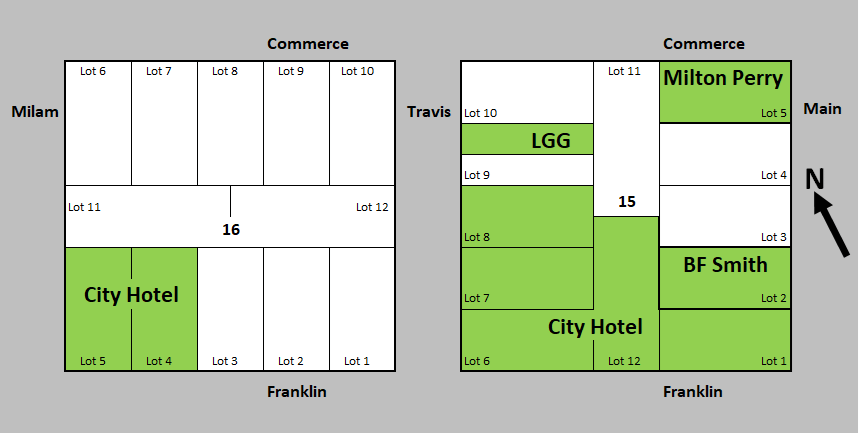
Image 1. Ownership of the lots in Block 15 and Block 16 late in 1837 based on Harris County Deed Records. Map by author.
Houston’s First Hotel: Introduction
Houston’s First Hotel: Elisha Floyd
The City Hotel Stables
Houston’s First Hotel: Levenhagen & Company
Carl B Fanger, City Treasurer and Hotelkeeper
Houston’s First Hotel: TBJ and Piety Hadley
Houston’s First Hotel: The Last Owners
Houston’s First Hotel: Conclusions
While the consensus of historians of the American hotel holds that these emerging venues served the demands of modern transportation, inns and taverns have always served intercity transportation. The only difference is that these long-distance travelers moved on slower conveyances. For example, one study of ancient Pompeii surveyed “transportation properties,” and identified eleven of these as inns. Remnants of ancient ramps provide archaeological evidence that there were stables attached to the properties. Drivers of freight wagons needed lodging and refreshment, but also needed facilities for storing their vehicles and livestock. While I am not aware of any particular freight drivers who lodged and boarded at the City Hotel, there were probably overland travelers who stayed there, and these guests would have arrived via horseback or stage coach in nearly all cases before 1856. Some of these arrivals needed storage for their vehicles and room and board for their livestock, hence the necessity for stables, whether these were under the direct management of the hotel or contracted with third parties.1
There are two excellent studies of nineteenth-century urban horse populations to guide us regarding the problems of stables. In addition, there was some collaboration of the authors of these two books, since they were published at nearly the same time. Clay McShane’s and Joel A. Tarr’s study of urban horses provided most of its examples from major cities of the Northeast, especially New York City. There are three possible types of stables that might apply to antebellum Houston. Livery stables were businesses that bought and sold horses. Boarding stables were businesses that sheltered and fed horses for a fee. Earlier in the nineteenth century, livery stables and boarding stables were poorly distinguished. It is plausible that the City Hotel contracted a with third party engaged in the livery-boarding stable business, if these two kinds of businesses were not well distinguished in Houston between 1837 and 1859. Tarr and McShane also identified private stables as a third type, smaller operations that might be consistent with the needs of a small caravansary such as the City Hotel. These were typically the businesses of urban horse owners who stabled other people’s horses to earn extra income.2
Documentation for stables associated with the City Hotel dates as early as 1837. Elisha Floyd and Thomas Scott advertised stables in their first advertised, “their stable as will secure the best possible accommodation for horses.”3
A possible location of the City Hotel’s stables was the northeast corner of Franklin Avenue and Milam Street. Floyd and Scott owned these two lots in July 1837 (Image 1). The Houston Town Company sold a half lot on the City Hotel block on 9 December 1837 to Lemke, Gosh, and Green, but it is not known what business they were running, but the size of the lot is consistent with a private stable.4
While its contractual relationship with the City Hotel is not mentioned, Fanger & Bowman also sold $410 worth of hay to the managers of the adjacent stable while they were managing the hotel. After Carl Fanger’s death, Ferdinand Gerlach took over the management of the hotel and engaged Alex H Moore to run the stable. While the location and the configuration are unknown, this is direct evidence for a stable at the hotel.5
Eric E. Poehler, “Where to Park? Carts, Stables and the Economics of Transport in Pompeii,” in Rome, Ostia, Pompeii: Movement and Space, Ray Laurence and David J. Newsome, eds. (Oxford: Oxford University Press, 2012), 194–214.
Clay McShane and Joel A. Tarr, The Horse in the City: Living Machines in the Nineteenth Century (Baltimore: Johns Hopkins University Press, 2007), 112–20.
Deed, Ben Fort Smith to Thomas Scott and Elisha Floyd, 8 June 1837, Harris County Deed Records, Book A, pp. 285–6, Harris County Archives, Harris County Clerk’s Office, Houston; Deed, Augustus Allen and John Allen for the Houston Town Company to Lemke, Gosh, and Green, 9 December 1837, Harris County Deed Records, Book A, p. 436, Harris County Archives, Harris County Clerk’s Office, Houston.
Estate of Carl B. Fanger, Harris County Probate Records, Volume D, p. 165. For announcement about the stable, see Morning Star (Houston), “Auction Sales,” 22 January 1840, Portal to Texas History.
Jon: What do you know about the Main Street fire in October 1862? It consumed many buildings including the Presbyterian Church (Main at Capitol) and the Masonic Hall across the street. I am researching the history of Masonic buildings in Houston and would love any pointers that you have. lindadodge at yahoo dot com.