
Emma Angell, Housekeeper
Rooming Houses and Boardinghouses

Boardinghouse Biographies
Elizabeth E Hay, Boardinghouse Keeper and Boardinghouse Client
Bridget Gallagher, Boardinghouse Keeper and Grocer
The Paulina Rosenfield Boardinghouse
Millie Gray and Her Boardinghouse on Courthouse Square, Houston
Emma Angell
Henrietta Bottler
Charles and Marie Kodtler
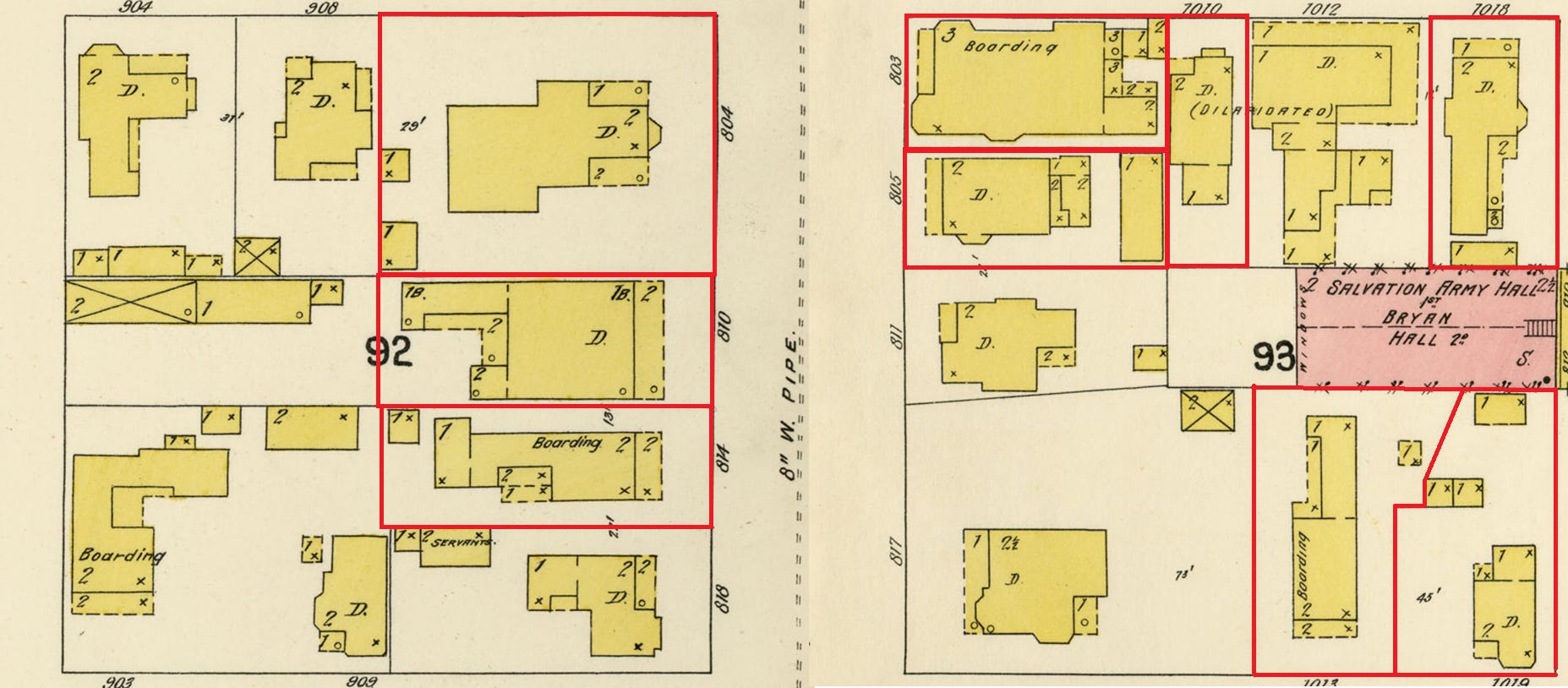
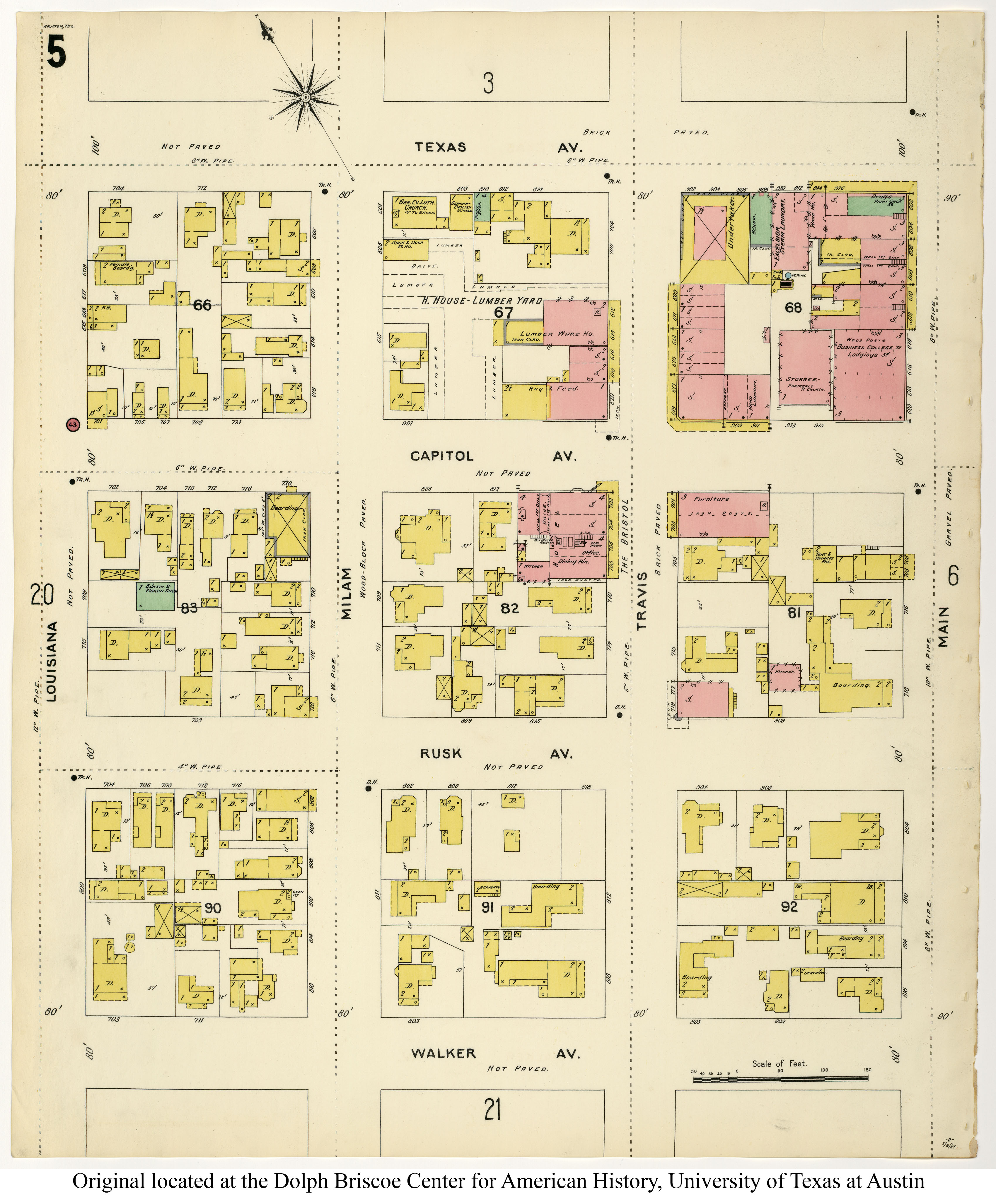
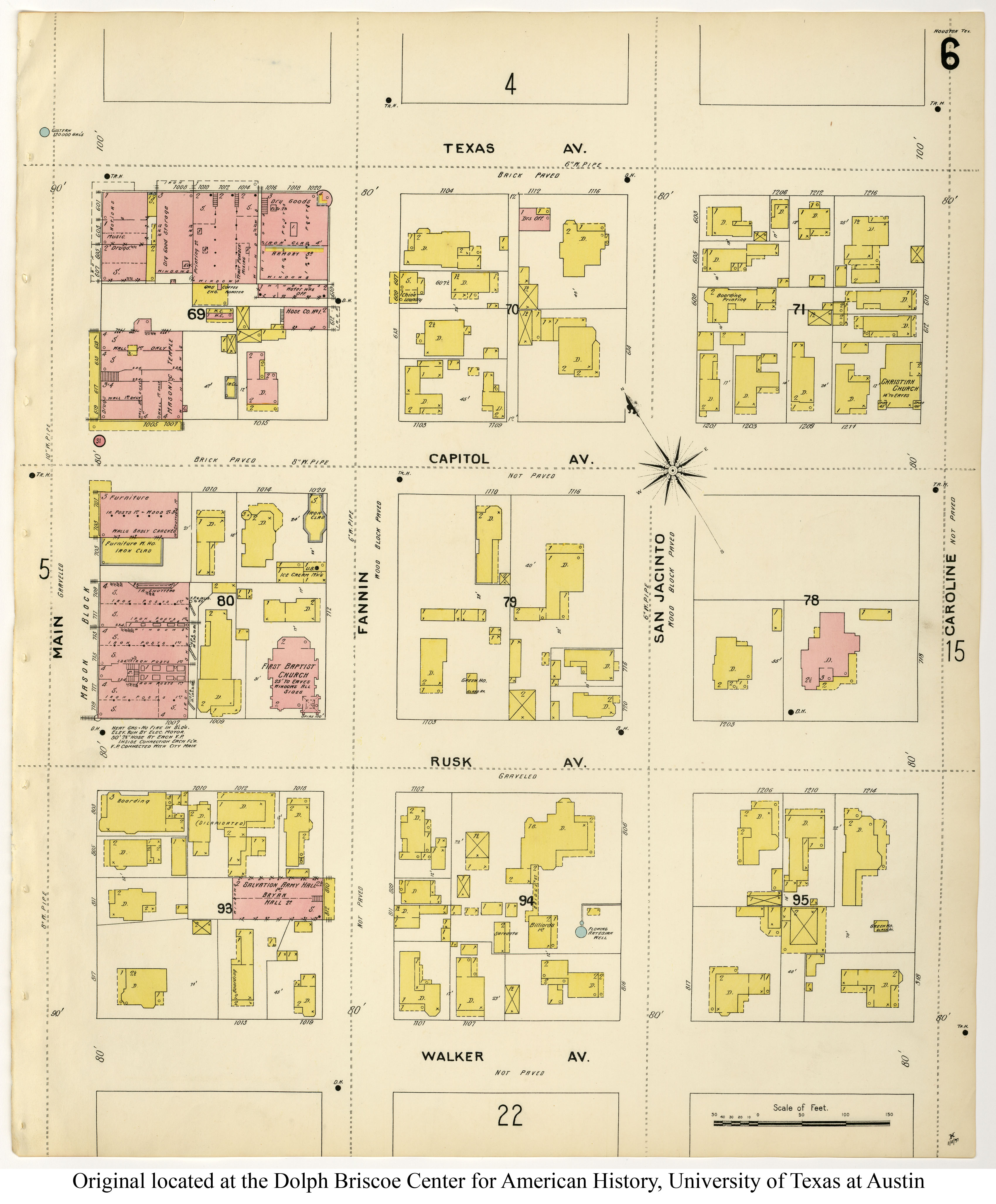
Image 1. “1896 Sanborn Map of Houston,” Facet 5 and Facet 6. The red boxes indicate boardinghouse or rooming house properties known for 1900. Image source: annotated by author.
Early Life
Emma E (Harris) Angell (1850–1936) was a long-time housekeeper in Houston. In three times during her life, she resided in a group-living facility, but in three distinct roles. In the first, Angell boarded as a young bride; in the second, she ran rooming houses and boardinghouses to cope with widowhood; and in the last, she resided in an apartment hotel as an elderly woman.
Angell can be identified in historical records as early as 1870, when she was residing in a boardinghouse in Clarke County, MS. At the age of nineteen, she was probably married to George Angell, a twenty-three-year-old railroad engineer, where they were boarding with another railroad engineer. Ten years later, the Angells were living in Jackson, TN in a closed nuclear household with four children, ages two through seven. George was an engineer for the Mobile & Ohio Railroad, but died on 7 December 1880 in a railroad crash near Corinth, MS.1
Angell Arrives in Houston
Boardinghouses were often the best occupational options for widows such as Angell. Her name next appeared in documents in 1884, when she lived in Houston’s Fifth Ward. She was the head-of-house at the southwest corner of Eagle and Hardy streets. There were many railroad jobs available in this neighborhood. However, in the 1880s and 1890s, hospitality trended toward more specialization. These trends included greater specialization in hospitality, such as restaurants and eating houses. Part of this was the development of commercial efficiencies of equipment, cooking techniques, and better organization of staff. A large commercial kitchen optimized to produce at-scale could serve palatable food more cheaply than boardinghouse women with their smaller kitchens and staffs. Other options for diners were small, specialized cookshops operating out of stalls at markets and train stations. The fruit stand was a fast-food option available in some neighborhoods in Houston.2
Within this changing hospitality landscape, Angell started a rooming house in 1886. Perhaps she started small, since there were only two roomers listed at the Angell house in the 1886 city directory, one carpenter, and one widow without occupation. Angell only accepted one roomer in 1887, or at least, only one who shared their information during the canvass of that year’s city directory. In 1889, Angell served meals to at least two resident boarders.3
By 1890, however, Angell moved out of the Fifth Ward into a remote location in the Third Ward. George Smith was the only boarder listed in that house. Angell moved to a middle-class neighborhood by 1892. She ran her new house at 806 Rusk Avenue in the Fourth Ward. That neighborhood included hotels and boardinghouses as dining options for Angell’s four roomers. Two of these roomers were day boarders within the same neighborhood. William W Sherrod boarded with Margaret Marrast, who was located about a block away at the northwest corner of Main Street and Rusk Avenue. The house of Emily Gearing at 805 Main Street was a perfect complement to Angell’s rooming house. In 1892, Gearing offered meals, but no lodging. Angell and Gearing were separated by a distance of only two blocks. Angell took in at least three roomers in 1894.4
Angell moved her residence again in 1895 and returned to serving boarders. She did not remain at 509 San Jacinto Street for long, however, and returned to her former neighborhood. Her latest address was 803 Main at the corner of Rusk Avenue. Angell resided at this corner from 1897 through 1910.5
Houston entered a new era of economic development after 1900. This development surged south down Main Street, fueled by new oil money from Spindletop. There was no oil in Houston, only oil money. While new derricks sprouted near Beaumont, steel-framed skyscrapers sprouted on Main Street in Houston. The Fort Worth engineering firm of Sanguinet & Staats built the first of these giants to occupy upper Main Street in 1910. Innocent locals feared that the first of these skyscrapers would collapse, anointing it “Carter’s Folly.” The ten-story Carter Building took the place of Rebecca Simpson’s former rooming house at 804 Main Street.6
Even as a few of these Victorian dwellings in Angell’s neighborhood were being replaced by steel towers, she persisted in her business at 803 Main through 1910. Angell submitted a listing to the classified business sections of the city directories and continued this practice through the decade. Still, not many of Angell’s roomers and boarders were listed in the city directories. Either Angell served only a few clients or else her clients preferred to maintain their privacy. The census provides a more accurate representation of the household population. The only Angell household located in the census so far was in 1910, when the enumerator represented 803 Main Street as a dwelling with two families. Angell headed Family 33, which included her daughter Algie, her mother Martha Clark, a mixed-race servant, two roomers, and four boarders. Two families resided within Family 34. James and Ellie Jones, boarded with Angell, and so did three of their sons. The family was a married couple named Briggs. However the house had been subdivided, the dwelling at 803 Main supported seventeen residents, fifteen of whom took their meals there as well.7
The Plaza
In 1930, Emma was living in her daughter Algie’s apartment. This was perhaps not an apartment in present-day terms. Algie and Emma were residing in the Plaza Hotel on Montrose Boulevard. Not only was this an apartment hotel, the Plaza was located within one of the most fashionable suburban neighborhoods on its most fashionable street. The Plaza and its neighborhood were still new and fresh. Montrose Boulevard was not even twenty years old in 1930 and the fine arts district of Houston was a work-in-progress. For $100 per month, a single, middle-aged daughter and her aged and widowed mother enjoyed a relatively care-free apartment-hotel life. While this biography does not include a sufficient study of the suite of services offered at the Plaza, each apartment was fully furnished and included a kitchenette with a refrigerator. The ground floor of the building included a small grocer and a dining room, that offered service either table d’hôte or a la carte. For at least a short time, a Widow’s Club met at the Plaza.8
Angell died on 24 April 1936 at the age of eighty-five. She had resided in Houston for about fifty years and operated rooming houses or boardinghouses for more than two decades.
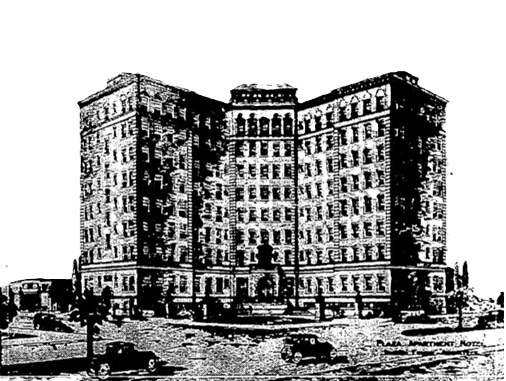
Image 2. Houston Chronicle, “Latest Apartment Planned Here,” April 1925, Illustration. Image source: NewsBank.
Conclusion
The biography of Emma Angell is valuable as perhaps the most complete timeline of any boardinghouse keeper in nineteenth-century Houston. Starting in 1884, Angell appeared in nearly every city directory through at least 19XX and in censuses for 1860, 1870, 1880, 1910, 1920, and 1930. Angell operated both boardinghouses and rooming houses, and her decisions whether to offer meals should be understood as a carefully considered marketing choice based on symbiosis within the neighborhood. Angell never served a large number of boarders or roomers, so she balanced a level of income with maintaining a level of comfort for her guests, herself, and her family.
Angell’s first rooming house was located in an industrialized neighborhood within the Fifth Ward. Her late husband had been a railroad engineer, so this was perhaps a type of environment that was familiar to her when she arrived in Houston. However, by the mid-1890s, she moved to a middle-class neighborhood near Rusk Avenue and Main Street. This neighborhood included such persons in the 1870s as Charlotte Allen, Edward B Noble, and Andrew J Burke. This neighborhood was solidly middle-class in the 1870s and 1880s, even if Allen was a local elite. Boardinghouses peppered in the neighborhood did not degrade its desirability. Yet Angell missed the salad days of this neighborhood, arriving just a year prior to Allen’s death. When Angell switched from the rooming business to the boarding business, she moved to Main Street at Rusk Avenue, sharing an intersection with the former Allen House and Rebecca Simpson’s rooming house. Even with this comprehensive study of Angell’s life, however, there are some significant gaps in the narrative. For example, the research here failed to reveal her records for the 1900 and 1920 censuses. Second, the Houston History Research Center archives for the city directories are not complete for the 1920s and -30s.
Even with hired staff and modern technologies, the physical and psychological demands of professional housekeeping are substantial. As with other housekeepers profiled, many women transitioned in retirement from providing housekeeping to receiving housekeeping. Living in an apartment hotel with a daughter is yet another variation of this phenomenon. A more complete biography would include a study of the Plaza Hotel and apartment hotels generally to provide context for Angell’s retirement.9
Ninth United States Census (1870), “George Angell,” 23 July 1870, Clarke County, MS, District 2, Ancestry [subscription required]; Tenth United States Census (1880), “George Angell,” 10 June 1880, Madison County, TN, Jackson, District 101, Ancestry [subscription required]; Chattanooga Daily Times, “Railroad News,” 12 December 1880, Newpapers.com [subscription required]; The Milan Exchange (Tennessee), “Railway Racket,” 13 January 1881, Newspapers.com [subscription required]. Familial relationships cannot be determined through the 1870 census alone. The 1870 census record for George Angell makes it certain that George and Emma were co-residents, but it was merely consistent with that of a married couple.
Morrison & Fourmy, Directory for the City of Houston, 1884–85 (Houston: Morrison & Fourmy, 1884), 77, Houston History Research Center, Digital Archives.
Widows as professional housekeepers: Howard P. Chudacoff, The Age of the Bachelor: Creating an American Subculture (Princeton: Princeton University Press, 2000), 89; Elizabeth S. D. Englehardt, Boardinghouse Women: How Southern Keepers, Cooks, Nurses, Widows, and Runaways Shaped Modern America (Chapel Hill: University of North Carolina Press, 2023), especially 45–59; Wendy Gamber, The Boardinghouse in Nineteenth Century America (Baltimore: Johns Hopkins University Press, 2007), 35, 39, 49, 54, 59, 110–3; Richard Harris, “The End Justifies the Means: Boarding and Rooming in a City of Homes, 1890–1951,” Journal of Social History 26, No. 2 (Winter 1992): 343; Dorothy Knox Howe Houghton, Barrie Scardino Bradley, Katherine S. Howe, and Sadie Gwin Blackburn. Houston’s Forgotten Heritage: Landscapes, Houses, Interiors, 1824–1914 (College Station: Texas A&M University Press, 1991), 292; Joan Jenson, “Cloth, Butter, and Boarders: Women’s Household Production for the Market,” Review of Radical Political Economics 12, No. 2 (1980): 21; Gary B. Nash, The Urban Crucible: The Northern Seaports and the Origins of the American Revolution (1979 abridged; Cambridge: Harvard University Press, 1986), 120–1; Richard Pillsbury, From Boarding House to Bistro: The American Restaurant Then and Now (Boston: Unwin Hyman, 1990), 20; Melissa Scopilliti and Martin O’Donnell‚ “Roomers and Boarders: 1880–2025.” Paper presented at the Annual meeting of the Population Association of America‚ New Orleans‚ 17–19 April 2008; Gwendolyn Wright, Building the Dream: A Social History of Housing in America (Cambridge: MIT Press, 1981), 37.
Efficiency of commercial food production and food service: Pillsbury, From Boarding House to Bistro, 35, 37–8; Katie Rawson and Elliot Shore, Dining Out: A Global History of Restaurants (London: Reaktion Books, 2019), 37–41, 103–6, 161–5.
Morrison & Fourmy, Directory for the City of Houston, 1886-87 (Houston: Morrison & Fourmy, 1886), 65, 284, Houston History Research Center, Digital Archives; Morrison & Fourmy, Directory for the City of Houston, 1887–88 (Houston: Morrison & Fourmy, 1887), 63, 79, 109, Houston History Research Center, Digital Archives.
Morrison & Fourmy, Directory for the City of Houston, 1890–91 (Houston: Morrison & Fourmy, 1890), 85, 241, 378, Houston History Research Center, Digital Archives. Morrison & Fourmy, Directory for the City of Houston, 1892–93 (Houston: Morrison & Fourmy, 1892), 92-3, 284, 419, 422, Houston History Research Center, Digital Archives. Morrison & Fourmy, Directory for the City of Houston, 1894–95 (Houston: Morrison & Fourmy, 1894), 90, 127, Houston History Research Center, Digital Archives; Jon Boyd, “Charlotte Marie Baldwin Allen and Allen House: A Case Study of a Boardinghouse in Nineteenth-Century Houston,” unpublished.
Jon Boyd, “Allen House After Charlotte Allen, 1896–1977,” 29 May 2026, What Are Streets For. Morrison & Fourmy, Directory for the City of Houston, 1895–96 (Houston: Morrison & Fourmy, 1895), 83, 210, 330, 352, 370, Houston History Research Center, Digital Archives.
The impact of Spindletop on commercial development in Houston: David G. McComb, Houston: A History (1969; Austin: University of Texas Press, 1981), 80; Works Projects Administration Writers’ Program, Houston: A History and Guide (Houston: Anson Jones Press, 1942), 161-3; Paul McAllister, “The Most Impossible Rise of a City Ever: Houston, Texas,” Video, starting at minute 9:00, YouTube.
Skyscraper development on upper Main in the 1910s: Barrie Scardino Bradley, Improbable Metropolis: Houston’s Architectural and Urban History (Austin: University of Texas Press, 2020), 85-6; McComb, Houston: A History, 98; Steven Fenberg, Unprecedented Power: Jesse Jones, Capitalism, and the Public Good (College Station: Texas A&M Press, 2011, 50-4; Jon Boyd, “Allen House After Charlotte Allen, 1896-1911,” 29 May 2026. What Are Streets For.
“Carter’s Folly”: WPA Writers, Houston: A History and Guide, 108; “JW Marriot Downtown Houston,” Wikipedia; Houston Archaeological and Historical Commission, “Samuel F. Carter Building—Second National Bank Building,” 24 March 2011, Certificate of Appropriateness, p. 2 (.pdf).
Commercial development replacing residential land use in this rooming house neighborhood: Boyd, “Allen House After Charlotte Allen.”
Thirteenth United States Census (1910), “Emma Angell,” 18 April 1910, Houston, Third Ward, District 0086, Ancestry [subscription required].
Fifteenth United States Census (1930), “Emma Angell,” 9 April 1930, Houston, Justice Precinct 1, Block 3028, Ancestry [subscription required].
This biography uses “apartment hotel” uncritically. The Plaza Hotel was opened in 1926, when only the original Museum of Fine Arts of Houston was open. The Houston Fine Arts District was still nascent in 1930. Bradley, Improbable Metropolis, 127; Stephen Fox, “Response to Gail Peter Borden, Michael Bell, and Eunjeong Seong, ‘Is Housing Still Housing,’” 3 March 2025, Exhibition Opening, Mashburn Gallery, Gerald D. Hines College of Architecture and Design, University of Houston. Houston Chronicle, “Begin Work on Hotel Here,” 11 January 1925, NewsBank [subscription required]; Houston Chronicle, “Work Has Started on City’s New Eight-Story Apartment Hotel Building in Montrose,” 29 March 1925, NewsBank [subscription required]; Houston Chronicle, “Now Open: The Plaza Apartment Hotel,” 25 April 1926, NewsBank [subscription required]; Houston Chronicle, “Plaza Hotel’s Dining Room Will Be Opened Tonight,” 28 October 1926, NewsBank [subscription required]; Houston Chronicle, 7 April 1929, Page 28, Column 3, NewsBank [subscription required].
Interpretations of apartment hotels: Fox, “Response to ‘Is Housing Still Housing,’” PAGE; Catherine Cocks, “Hotels,” in Encyclopedia of Urban America: The Cities and Suburbs, Neil Larry Shumsky, ed. (Santa Barbara, CA: ABC-CLIO, 1998), Volume I, 356; Elizabeth Collins Cromley, Alone Together: A History of New York’s Early Apartments (Ithaca, NY: Cornell University Press, 1990), 189, 193-8; Paul Groth, Living Downtown: The History of Residential Hotels in the United States (Berkeley: University of California Press, 1994), 32–3, 52, 63, 84, 124; Betsy Klimasmith, At Home in the City: Urban Domesticity in American Literature and Culture, 1850–1930 (Hanover, NH: University of New Hampshire, 2005), 164, 256n12; A. K. Sandoval-Strausz, Hotel: An American History (New Haven: Yale University Press, 2007), 275-6; Gwendolyn Wright, Building the Dream: A Social History of Housing in America (Cambridge, MA: MIT Press, 1981), 94, 136-41.