
Houston's First Hotel: Conclusions
Heavy on Facts; Light on Interpretations

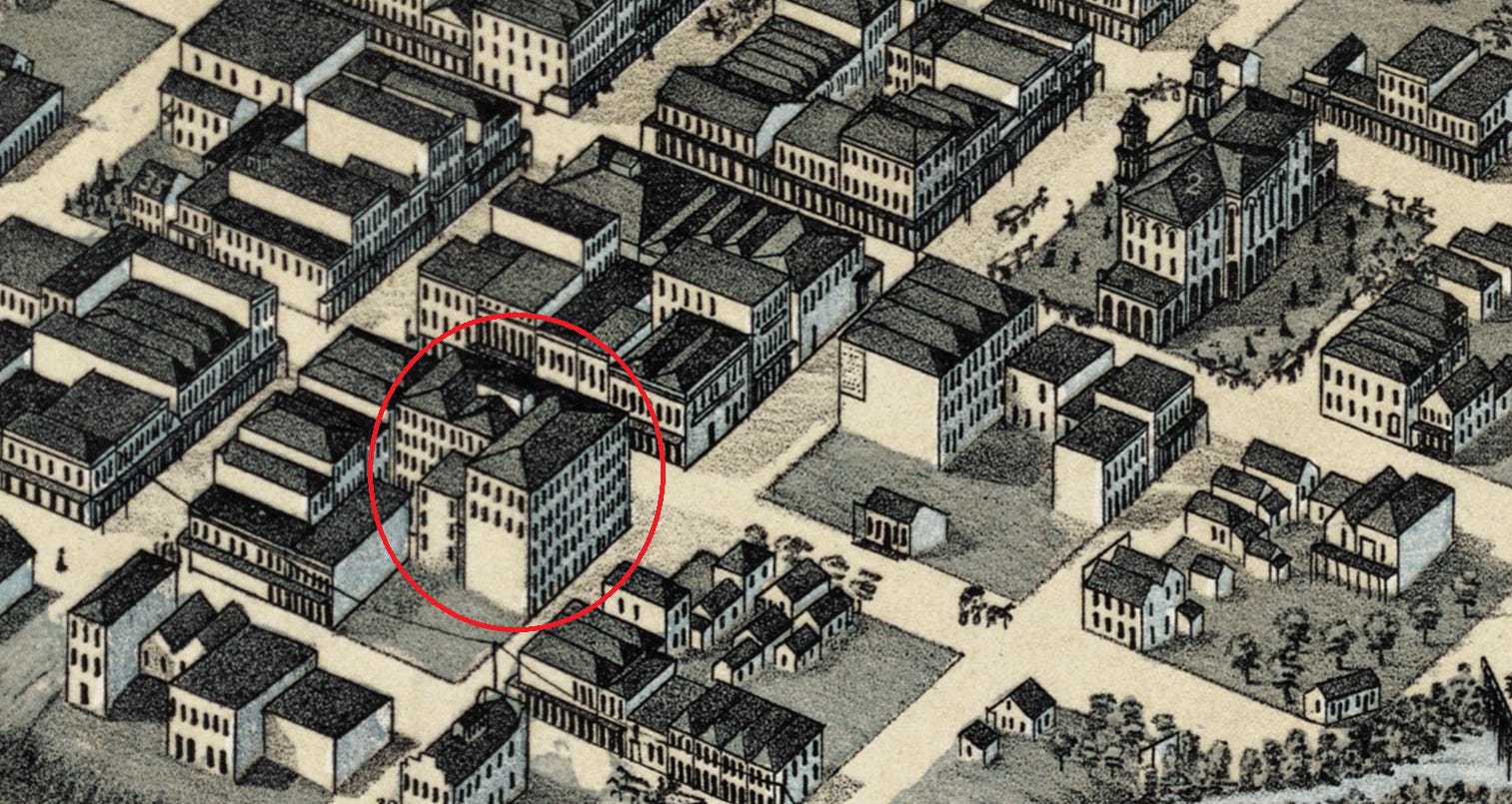
Image 2. Augustus Koch, “Birdseye View of Houston,” 1873, Illustration. Hutchins House occupied some of the former City Hotel lots. Image source: Wikipedia Commons. Annotated by author.
Houston’s First Hotel: Introduction
Houston’s First Hotel: Elisha Floyd
Houston’s First Hotel: Levenhagen & Company
Carl B Fanger, City Treasurer and Hotelkeeper
Houston’s First Hotel: TBJ and Piety Hadley
Houston’s First Hotel: The Last Owners
Houston’s First Hotel: Conclusions
The “Houston’s First Hotel” series presents the most complete account of the City Hotel in Houston to date. It is a factually rich narrative covering several aspects of the history of the hotel. This is the first narrative to reliably report a nearly complete ownership chain of the property, beginning with its development in early 1837 by Benjamin Fort Smith until its permanent closure by William J Hutchins in 1859. To the greatest extent possible, “Houston’s First Hotel” reported tenant proprietors and subcontractors who were managing its operations. The series considered possible locations for the City Hotel stables.
A summary timeline of the City Hotel begins with Frank Lubbock’s recollection of workmen carrying construction supplies to the site. We can date Lubbock’s arrival in Houston as early as 21 January 1837. The Houston Town Company, however, did not formally commit the sale of town lots to Smith until 24 February. Smith sold the hotel to Scott and Floyd on 15 March 1838, although they announced their ownership in June 1837. Floyd managed the hotel alone after Scott left, but took on Sidney Collins as a junior partner. Floyd did not persist in the hospitality business for long, though, and sold the property to Henry Levenhagen in September 1838. Levenhagen ran his hotel and dry goods business with Ferdinand Gerlach, and leased the hotel to Charles Baumann and Carl Fanger. Meanwhile, Levenhagen attracted various investors to provide bridge loans until 1845, when the Harris County District Court ordered civil forfeiture in favor of Floyd and Scott. TBJ and Piety Hadley acquired the City Hotel, but did not appear to manage it themselves. The Bretterkasten collapsed the first time in 1855. In 1857, the Hadleys sold the hotel to a partnership of William J Hutchins, Benjamin A Shepherd, and Andrew J Burke. Hutchins bought all outstanding shares of the City Hotel in 1859. The main building in the City Hotel complex collapsed a second time in 1859, and was permanently closed at that time. Hutchins was already redeveloping the Main Street frontage of the complex as the Hutchins Building in 1859 (not to be confused with the post-war Hutchins House).
Historians always want to know why events unfold the way they do, but first they need to know what happened. For those who wonder why “Houston’s First Hotel” reports facts in such painstaking detail, “Houston’s First Hotel” is light in historiography and heavy in facts because we need to know what happened before meaningful historical interpretation is possible. The historical corpus for nineteenth-century Houston contains gaping holes for many events and even periods. In particular, group living has been barely considered by local historians, and filling this breech is my historical mission. The yeoman’s work of fact-finding is the first step. With these novel factual narratives, perhaps those with better interpretive skills can use “Houston’s First Hotel” and other hotel biographies, while adding a new interpretation.
One obscure note of interpretation of the City Hotel was raised by Edwin Bonewitz. He alleged that the City Hotel was developed by a partnership including Benjamin Fort Smith and Augustus Allen, with Michel Menard carrying the mortgage. This is a critical factual gap in “Houston’s First Hotel” with interesting implications. This requires researching the Harris County District Court archives.
Nineteenth-century hospitality in the Republic of Texas and the South used the labor of enslaved persons. The direct evidence for this is thin in the case of the City Hotel, but the sales contract conveying the hotel from Smith to Floyd and Scott contained a provision calling for human chattels to be held in security for the mortgage. This event merits a higher-quality interpretation than the one provided here. In addition, there was no attempt here to place slave labor at the City Hotel within the context of other hospitality venues for which direct and indirect evidence for slave labor is known to varying degrees. These include: Mansion House, Houston House, the Old Capitol Hotel, and Rusk House.
A minor interpretive success for “Houston’s First Hotel” is the presentation of the City Hotel as a local business and communications hub. A few Houston attorneys resided at the City Hotel while using it as their law office. Other professionals also used the City Hotel for meetings, including land agents, surveyors, and engineers.
My main research interest is residential boarding in the nineteenth century, whether it be in hotels, boardinghouses, restaurants, or coffee houses. There was only one US census conducted while the City Hotel was in operation: the 1850 census. I found no household record that could be identified as the City Hotel. There are a few hotel households evident in the 1850 census of Houston: Houston House and the Old Capitol Hotel.